The USD is lower as the US wakes to a holiday and they honor all those who have died on the battlefields, and the UK barbecues get heated up in observance of the May Bank Holiday.
With no escalation of the war in Iran and baby steps toward a diplomatic solution for now, hope vs despair is the theme. Pres. Trump is posting on Truth Social that he has instructed his people that he is in no rush, and that the deal must be all or nothing agreement. He has stressed that the deal will not be like the JCPOA agreement that Pres. Obama signed with Iran and which Trump threw out.
Below are some key points from the long post:
- Said negotiations with Iran are “proceeding nicely” but stressed it must be an “all or nothing” agreement.
- Warned that failure to reach a deal would mean a return to a larger and stronger military conflict.
-
Said he held discussions with leaders from:
- Saudi Arabia
- UAE
- Qatar
- Pakistan
- Türkiye
- Egypt
- Jordan
- Bahrain
- Called for those countries to simultaneously join the Abraham Accords as part of any broader Iran settlement.
- Said countries unwilling to sign onto the Abraham Accords “should not be part of the deal,” arguing refusal would show “bad intention.”
- Claimed the Abraham Accords have created a financial, economic, and social boom for current members.
-
Described a potential broader Middle East agreement as:
- A historic settlement
- A path toward regional peace and economic strength
- Potentially the “most important deal” ever signed in the region
- Suggested that if Iran reaches an agreement with the U.S., it could eventually also become part of the Abraham Accords coalition.
-
Said a unified Middle East could become:
- More powerful
- Economically stronger
- More stable than at any point in modern history
- Directed his representatives to begin working toward expanding participation in the Abraham Accords immediately.
So what is the Abraham Accord
The Abraham Accords are a series of diplomatic agreements brokered by the United States in 2020 aimed at normalizing relations between Israel and several Arab and Muslim-majority countries.
What the accords did.
The agreements established:
- Formal diplomatic relations
- Economic cooperation
- Trade and investment ties
- Tourism and travel links
- Security and technology cooperation
between Israel and participating countries.
Countries that joined
The original and subsequent participants included:
- United Arab Emirates
- Bahrain
- Sudan
- Morocco
Trump’s post referenced expanding the accords further to countries such as:
- Saudi Arabia
- Qatar
- Pakistan
- Türkiye
- Egypt
- Jordan
Why it was significant
Historically, many Arab nations:
- Did not recognize Israel
- Had no diplomatic relations
- Conditioned normalization on a Palestinian peace agreement
The Abraham Accords changed that dynamic by creating direct normalization agreements without first resolving the Israeli-Palestinian conflict.
Why it’s called the “Abraham” Accords
The name refers to Abraham, a central figure in:
- Judaism
- Christianity
- Islam
The idea was to emphasize common religious and historical roots across the region.
Market and geopolitical importance
The accords are viewed as:
- A major geopolitical realignment in the Middle East
- A counterweight to Iran’s regional influence
-
A framework for increased:
- trade
- defense cooperation
- investment
- energy partnerships
Trump’s latest comments suggest he wants to tie any future Iran agreement into a much broader regional diplomatic framework centered around an expanded Abraham Accords coalition.
Trump has a way of solving problems by creating problems. Is this another fly in the ointment that prolongs rather than advancing back toward peace.
A market overview:
The price of oil is down sharply. The current price is trading at $90.80 currently. That is down -$5.80 on the day or close to 6%. The low for the day reached $90.32. The high was up at $93.90.
Gold is higher on the lower USD with the price up $45 or 1% at $4554. Silver is up $2.22 or 2.93% at $77.28. The S&P mini futures in the US are up 0.98%
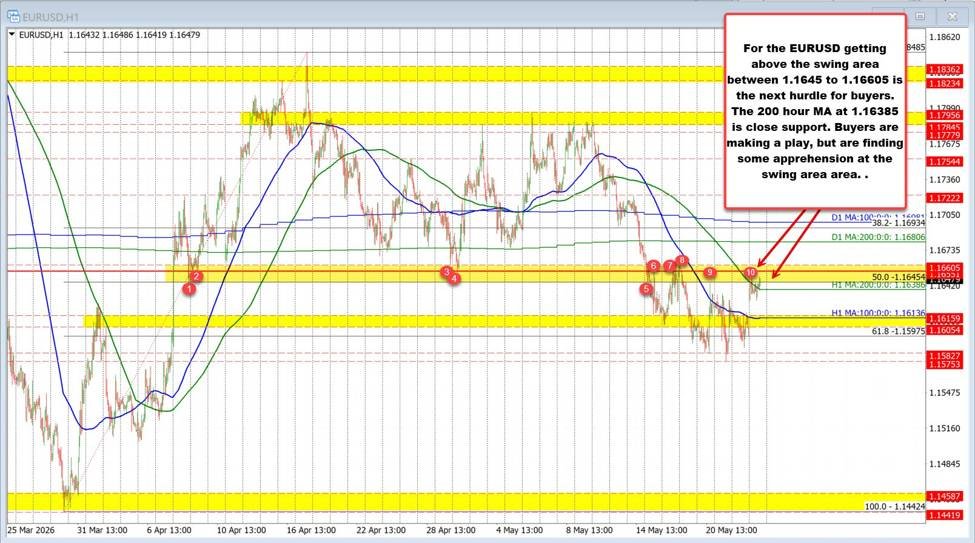
EURUSD: The EURUSD gapped higher at the start of trading today, but upside momentum has been less convincing since then, with the pair continuing to waffle above and below several key technical levels. The price is currently trading around the 200-hour moving average near 1.1638 and the 50% midpoint of the rally from the late-March low at 1.16454, keeping traders focused on that area as an important near-term battleground.
Adding to the significance of the zone is a swing area between 1.1645 and 1.1660 (highlighted by the red-numbered circles on the chart), where prior highs and lows have repeatedly stalled price action. If buyers can get and stay above this cluster of resistance levels, it would strengthen the bullish bias and shift the focus toward the 200-day moving average at 1.16806 and then the 100-day moving average near 1.1698. Until then, the pair remains in more of a consolidation phase with buyers and sellers battling for short-term control.
USDJPY: The USDJPY moved lower at the Asian-Pacific open, and that decline pushed the pair below the 100-hour moving average near 159.00, shifting the short-term bias modestly to the downside. However, sellers have not been able to generate sustained downside momentum, with the price continuing to hold above the 200-hour moving average at 158.71, helping to keep the broader trading range intact for now.
The high price today briefly extended above the 159.00 level to 159.04, but buyers could not maintain momentum above that key technical barometer and the pair rotated back lower. The low price reached 158.77, just above the 200-hour MA support level.
Going forward, the 100-hour and 200-hour moving averages will remain the key directional barometers. A move back above the 100-hour MA at 159.00 would tilt the bias back to the upside and give buyers more control. Conversely, a break below the 200-hour MA at 158.71 would increase the bearish bias and open the door for a deeper downside correction.
GBPUSD: The GBPUSD continued its move higher today, with buyers extending the rally above several key technical resistance levels. The pair pushed above the previously broken 38.2% retracement at 1.34669, along with the swing area between 1.3446 and 1.34669, and also moved above the 100-day moving average at 1.3475, strengthening the bullish bias.
During the European morning session, the pair did correct lower and briefly dipped below the 100-day MA, but importantly, sellers could not push the price back below the 38.2% retracement level. That helped confirm the breakout area as a near-term support zone and keeps buyers more firmly in control as long as the pair remains above those levels.
The rally has since extended to a new high of 1.3506, with the pair currently trading near 1.3500. Looking ahead, the next upside targets come in at 1.35318 and then 1.35516, corresponding with prior highs from May 12 through May 14. A move above those levels would further strengthen the bullish outlook and open the door for an extension toward higher swing targets.