➡️ Did someone forward you this email? If you would like to receive this information directly, every morning before the markets open in New York, sign up here.
ONE BIG THING
Bill Gates: The world is unprepared for 3 major AI risks—stunted child development; extreme criminality; and vanishing jobs
Microsoft cofounder turned billionaire philanthropist Bill Gates is a self-professed optimist when it comes to artificial intelligence. He’s had a front-row seat to its greatest advancements and believes it will help cure diseases and address inequality.
But in a new essay published today, Gates strikes a decidedly more cautious tone: “AI will either be the greatest equalizer ever invented, or the worst source of injustice,” he writes in the essay, shared with Fortune’s Eleanor Pringle ahead of publication. “The challenge is monumental.”
Gates said the world’s “top priority” should be ensuring AI is used as a force for good. But he continued: “Unfortunately, right now we are not preparing for it. I don’t see evidence that leaders, experts, and communities are confronting the challenges adequately. There is no plan to ease the entry into the AI era.”
MORE FROM FORTUNE
Can Jony Ive Revolutionize OpenAI? | Fortune Daily
Corporate America’s anti-woke retreat is reaching its limits – Scott M. Curran
Gen Z wants to be ‘tradwives.’ New data reveals the exact salary your spouse needs to earn—and in most states it’s under $100K – Orianna Rosa Royle
Instagram is like a digital cigarette and box of chocolates that ‘encourages gluttony.’ How do you fix that? – Tatiana Sataua
Deloitte puts the lunar economy at up to $566 billion by 2050—and SpaceX is speeding the timeline – Amanda Gerut
THE GULF
There is a deal to reopen the Strait of Hormuz, and Trump isn’t part of it—yet
The price of Brent crude oil declined to $85 per barrel this morning after the official Oman News Agency reported that Iran and Oman had discussed a “proposed framework” that would eventually lead to a “permanent navigational corridor” through the Strait of Hormuz. Oman’s foreign minister, Sayyid Badr bin Hamad Al Busaidi, met his Iranian counterpart, Dr. Seyed Abbas Araghchi, yesterday, ONA reported:
- “The two ministers discussed a phased framework that could provide a practical and implementable basis for moving forward, in light of the current situation in the Strait resulting from the recent war and its tragic repercussions. The proposed framework includes the establishment of a joint temporary navigational corridor through the Strait of Hormuz and an agreement to implement a joint project to clear the Strait of mines.”
- “Technical negotiations between the two sides would continue with a view to agreeing on a permanent navigational corridor and future administration of the Strait, as well as a mechanism for information-sharing, traffic management, and the provision of relevant navigational and security services.”
Context: That language about “administration” and the provision of “services” will likely involve shipping fees. The Strait was free before the war. The proposal also assumes that Iran and Oman will jointly control the Strait—a situation that will not be welcomed by their Gulf neighbors.
Don’t take the champagne out of the fridge just yet. Iran will decline to reopen the Strait until the U.S. honors what it had agreed to in the “memorandum of understanding” (MOU) back in June, according to Mokhtar Haddad, editor-in-chief of the Iranian newspaper Al-Wefaq, who cited Iranian officials. The MOU includes a cessation of all hostilities, an end to sanctions, and $300 billion in war reparations. It also includes a commitment by Iran to “not procure or develop nuclear weapons” but it allows for “enrichment and other mutually agreed matters related to the Islamic Republic of Iran’s nuclear needs.”
That places the ball in Trump’s court. He has an opportunity to end the war—but only if he can bring himself to agree to what he proposed earlier this year.
It’s just a rumor right now but … Russian media are reporting that Iran and the U.S. are discussing a new ceasefire.
THE MARKETS
Beat and retreat: what Nvidia keeps doing after earnings
Stock markets are mixed this morning as traders await Nvidia’s Q2 FY2027 earnings call after the close in the U.S. The company usually crushes expectations. If it doesn’t do that tonight, expect a wave of selling to kick off in the tech sector.
“In the past few years, Nvidia’s earnings have often been a big macro event, with reactions on par with U.S. jobs reports and CPI prints,” Peter Sidorov and his team at Deutsche Bank advised clients this morning. “But in the most recent quarters, the positive earnings surprises haven’t been as big as those in 2023-24, and after each of the last four earnings reports, Nvidia’s share price actually fell the next day.” Nvidia was up 2.19% yesterday and rose another 0.31% in after-hours trading.
- S&P 500 futures were down 0.06% this morning. The index was up 0.32% yesterday.
- In Europe, the Stoxx 600 was up 0.12% in early trading and the U.K.’s FTSE 100 was down 0.06% before lunch.
- Asia: South Korea’s KOSPI was up 0.97%. Japan’s Nikkei 225 was up 0.62%. India’s Nifty 50 was down 0.22%. China’s CSI 300 was up 0.85%.
- Brent crude was $85 per barrel this morning, down from a high of $89 yesterday.
- Bitcoin was $78.8K.
Don’t expect a roadmap from the Fed’s Warsh on Friday
The Fed’s Jackson Hole meeting will be a “snoozefest,” according to Chris Beauchamp, the chief market analyst at investing and trading platform IG. “You can’t blame investors for wanting clarity from Kevin Warsh at Jackson Hole—who wouldn’t want a nice little roadmap for the coming months, especially after Bessent’s decision to go rampaging through the Treasury markets last week,” he said in an email to Fortune. “But such hopes are likely to be dashed, given the new Fed boss’s preference for staying tight-lipped. The hawks on the FOMC continue to squawk loudly, but the chances of a hold are sticking firmly around 60%, and the speech is unlikely to move this much.”
THE NATIONAL DEBT
You can’t GDP your way out of $40 trillion in national debt
When asked about America’s $40 trillion in national debt recently, President Trump replied, “The way you take care of debt is with growth, and we have tremendous growth. We’ve never had growth like we have right now.”
Hold that thought. Over the first half of this year, the U.S.’s GDP growth was only the second-strongest in the G7. The growing-est country was, surprisingly, the normally sluggish U.K., per this chart from Pantheon Macroeconomics:
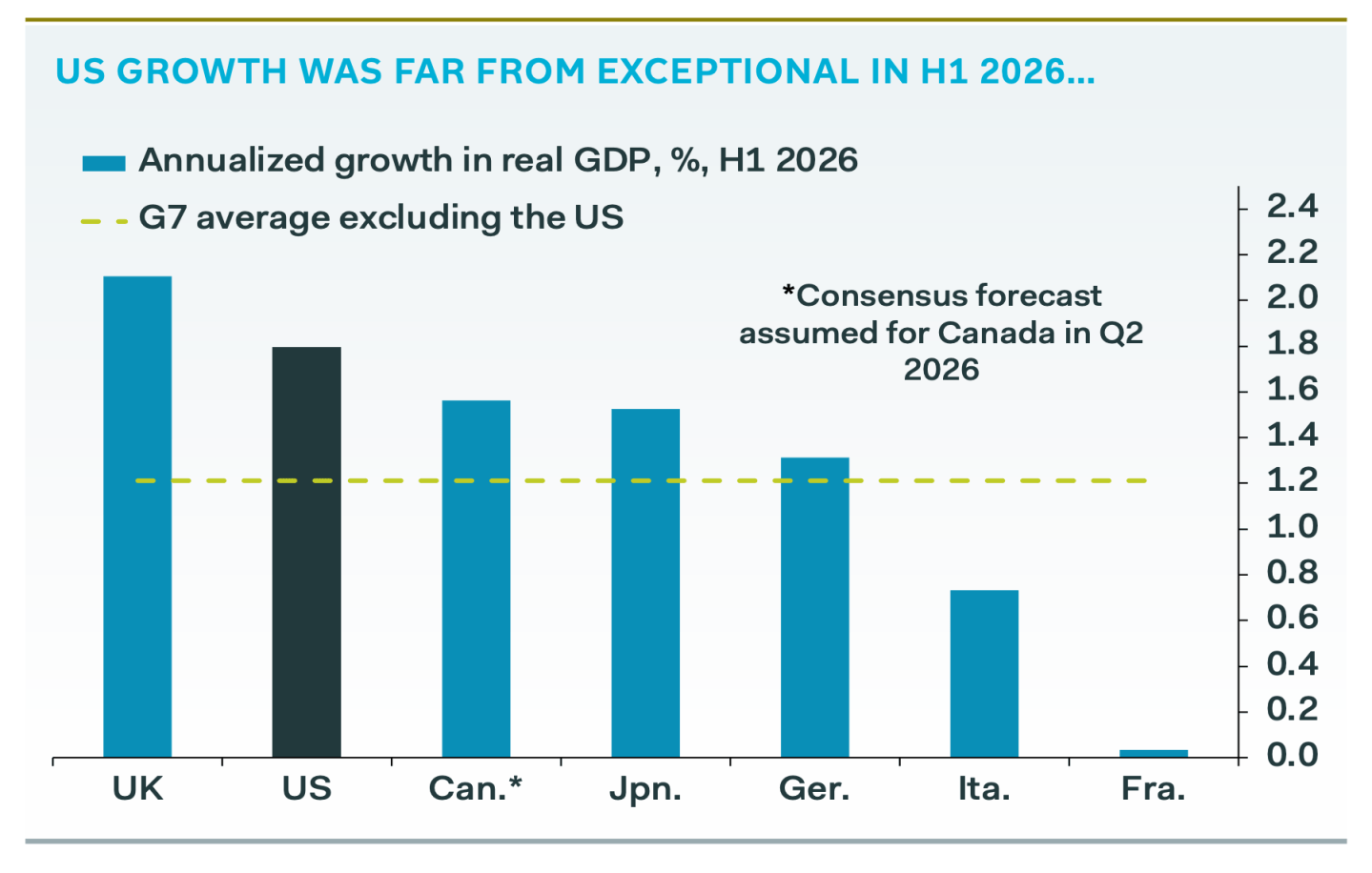
Don’t expect the U.K. to hold that lead. As Pantheon’s next chart shows, the U.S. still tops the G7 for growth over the longer term.
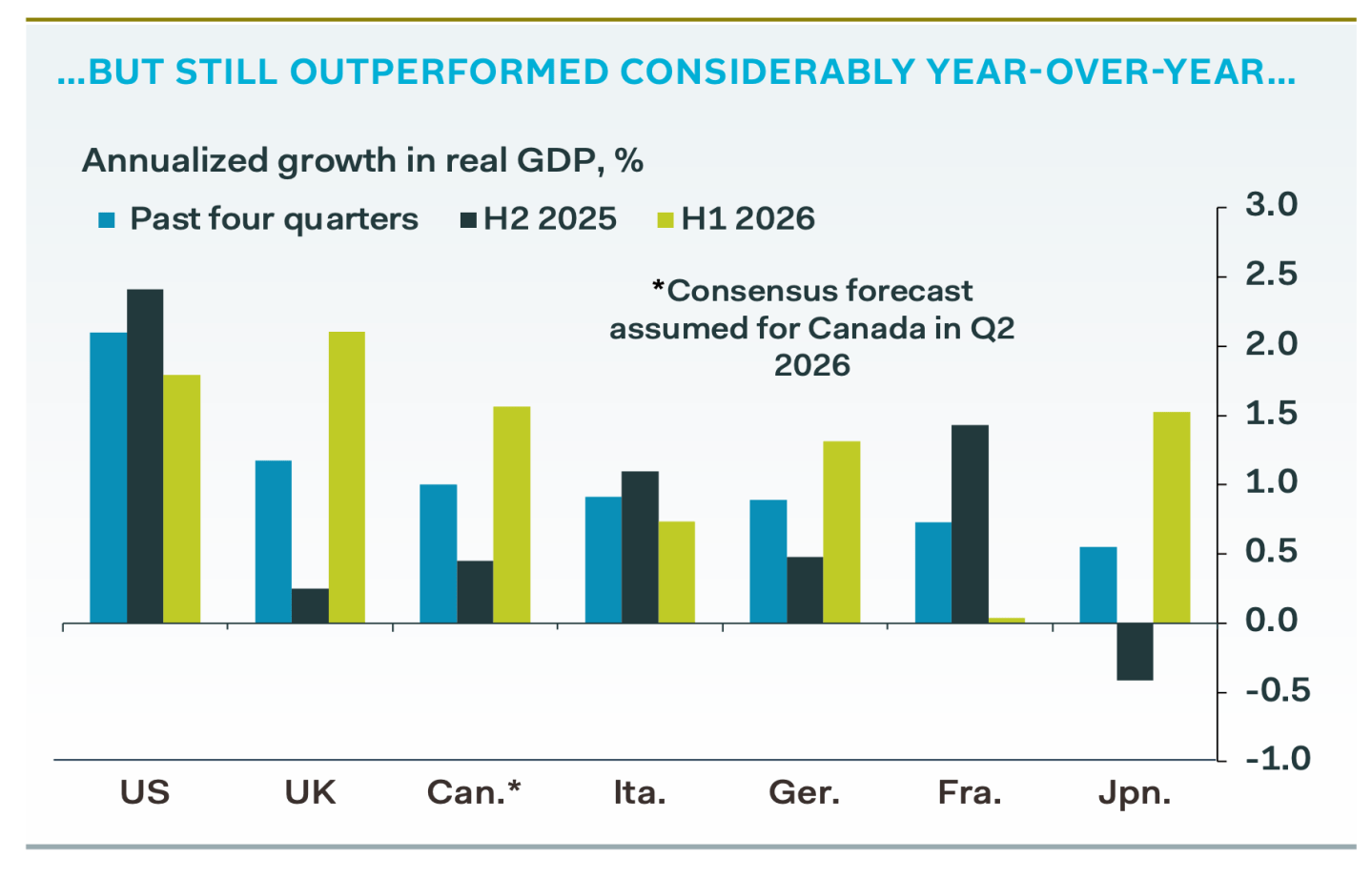
Anyway, revenons à nos moutons, as the French (also G7) say, is it possible for the U.S. to simply grow GDP faster than its debt and thus solve its fiscal problem? Pimco’s Libby Cantrill says no. The problem is that most government spending goes to mandatory programs like Social Security, Medicare, and Medicaid. To meaningfully reduce spending, you’d have to cut entitlements to one or all of them (or meaningfully raise taxes). Neither Democrats nor Republicans are willing to do that—because it would be electoral suicide:
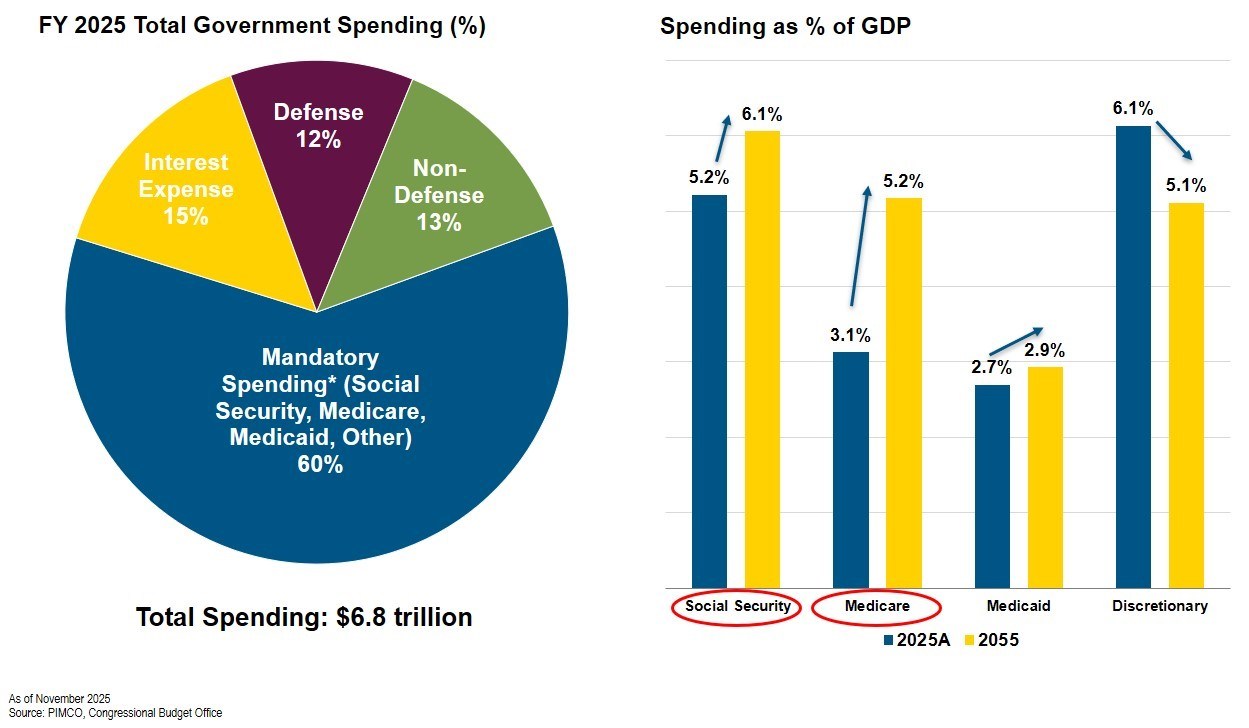
“Despite what both parties like to think and claim, both Republicans and Democrats have a spending and tax problem, and are both responsible for the run-up in debt,” she said in an email. “While there are some efforts on Capitol Hill to address the debt problem, they are mostly more symbolic than substantive at this point.”
THIS TIME IT’S DIFFERENT, UNFORTUNATELY
AI investment has yet to lead to significant gains in productivity
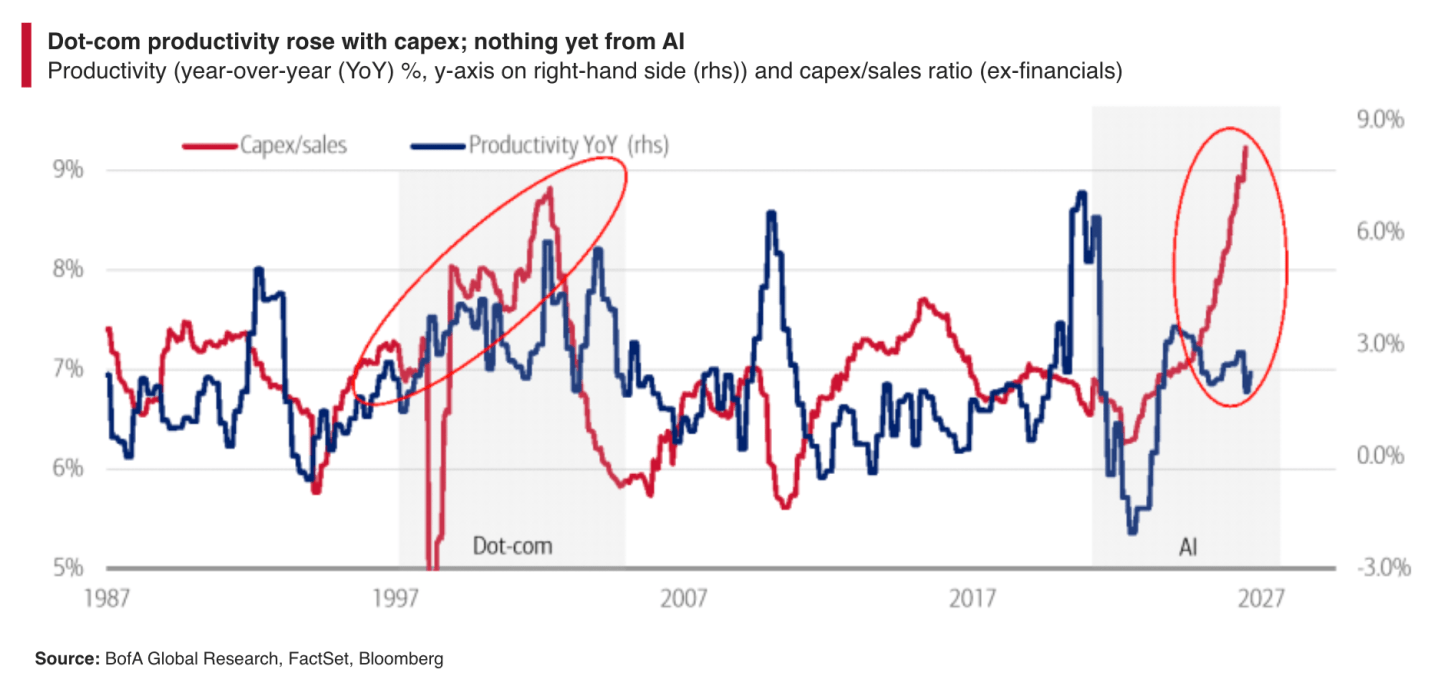
Tech capex and productivity gains are somewhat correlated, as this chart from Liz Everett Krisberg and David Tinsley at Bank of America shows—until recently. During the recent splurge in AI capex spending, productivity seems to have decoupled itself and is trending negative. (That’s bad news for Fed Chairman Kevin Warsh, who is very much hoping that productivity gains will reduce inflation.) “While AI capex is at a record high, national productivity growth is at 2.2%—just slightly above the 2% average since 1987. Conversely, the dot-com era (1996-2004) showed a clearer relationship between capex and productivity growth,” Krisberg and Tinsley said in an email.
NUMBER OF THE DAY: Profits, not people?
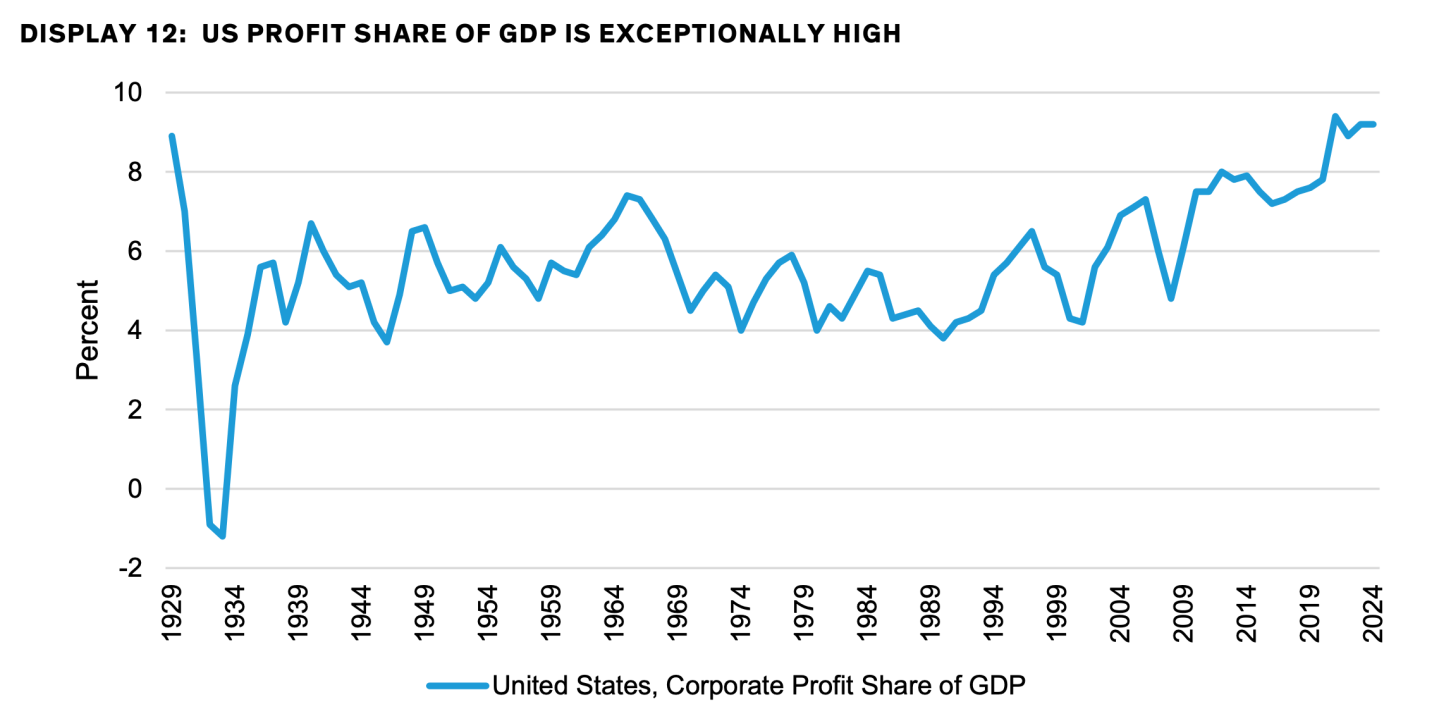
Just under 10%
The share of GDP that goes to corporate profits, according to AllianceBernstein’s Inigo Fraser Jenkins. If it rises higher, it increases the risk of political instability, he believes:
“This is exceptionally high in the U.S. In our five-to-10-year forecasts, we have stopped assuming that this mean reverts downward—in part because American voters seem oddly unconcerned by this increase of corporate power in recent decades. Moreover, the current choice (and it is a choice) that is being made is that private-sector corporations get to decide which AI is developed and deployed. If anything, this makes it likely that the profit share of GDP will rise even further in the near term. However, there has to be some limit. At some point, if corporate profit share rises too much, especially in step with an increase in wealth inequality, then the risk of a revolutionary backlash is implied,” he said in a recent white paper.
THE FRONT PAGES TODAY
Coinbase CEO weighs California exit over ‘deeply un-American’ wealth tax – NY Post
At Home and Abroad, Deference to Trump Turns Increasingly to Defiance – NYT
AI is supercharging hacks of everyday utilities – Axios
The Connections That Turned a Precocious Teen Into the Fallen ‘Nostradamus of AI’ – WSJ
Nvidia Earnings Give Investors a Barometer for State of AI Trade – Bloomberg
ONE MORE THING
Decorating a college dorm room now costs nearly $1,500
College move-in used to mean twin XL sheets, a shower caddy, and maybe a few posters taped to a cinder-block wall. For some families, that’s no longer going to cut it, Fortune’s Tatiana Sataua reports.
Parents are shelling out thousands of dollars to turn their kids’ temporary dorm rooms into carefully designed spaces, complete with custom headboards, wallpaper, matching bedding, and professionally installed decor. The trend has spawned an entire dorm-design industry and a steady stream of elaborate room reveals on TikTok and Instagram.
College students and their families are expected to spend a record $103.5 billion, or $1,437.79 per shopper, getting ready for school this year, according to the National Retail Federation and Prosper Insights & Analytics, up from $88.8 billion last year.
The price tags may raise eyebrows, but students are the ones living with the results. “No matter how people think how absurd spending all this money on your dorm room is, your kid’s gonna be here for the next nine months,” incoming James Madison University freshman Henley Bedwell said. “Why would you not rather them be comfortable?”