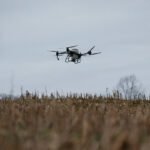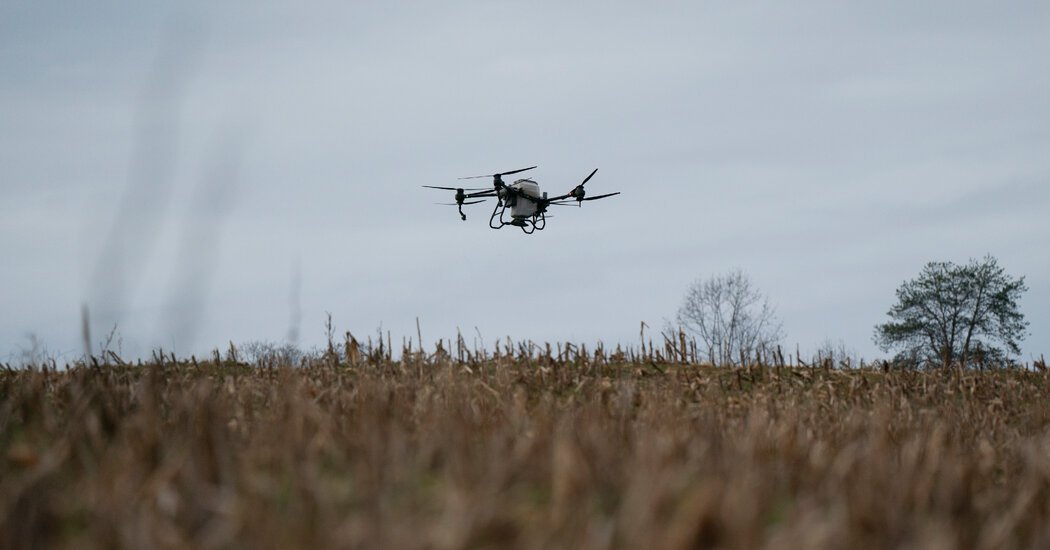
The Trump administration imposed tariffs of up to 100 percent on drones on Thursday, continuing its long-running campaign to thwart the Chinese drone industry and promote domestic manufacturing.
A 100 percent tariff applies to drones that weigh more than 55 pounds or use thermal imaging. Those drones, the vast majority of which are made in China, have become essential for many law enforcement officials, as they’re used to track wildfires and find lost people. Smaller drones have a tariff of 25 percent.
President Trump, whose two eldest sons have ties to the U.S. drone industry, announced the levies last month after a Commerce Department investigation deemed reliance on foreign drones and components a national security threat.
The Trump administration argued that the United States must be weaned off its reliance on China for drone technology. It is estimated that a single Chinese company — Shenzhen-based DJI — manufactures more than 70 percent of the world’s commercial drones.
But critics say that the domestic drone industry cannot fill the gap and that the administration’s abrupt policy changes will do more harm than good.
Scott Mlakar, chief of the Lake County Drone Unit, which is made up of police officers and firefighters outside Cleveland, said the new tariff was financially onerous and would put thermal drones out of reach for communities that needed them the most.
“Most of this, in our humble opinion, is lobbying by U.S. manufacturers to eliminate foreign competition,” he said. “This is not national security. It’s protectionism.”
His unit uses thermal drones daily to search for lost children and crime suspects at night, he said.
The move has dampened hopes that the United States could work with allies to build a supply chain that competes with China’s drone industry. Drones made by allies get a break on the tariffs, but don’t escape them completely. Those produced by the European Union, Japan, South Korea, Switzerland and Taiwan have levies of 15 percent, while those produced in Britain have a levy of 10 percent.
At the same time, the Federal Communications Commission has proposed reclassifying drones that use common technologies such as thermal imaging and aerosol spraying as “military grade.” Industry experts said that would amount to a retroactive ban on drones used by thousands of American businesses and public safety officials.
In December, the F.C.C. effectively banned the sale of new models of foreign-made drones without a special waiver. At the time, the agency said previously authorized models could continue to fly and be imported, but the current proposal would prohibit the import of many old models as well.
Many drone pilots hold out hope that the tariffs will eventually be lowered, as many other tariffs have been. But the F.C.C. proposal has caused deep anxiety and dominated conversations at a commercial drone expo in Las Vegas this week, attendees said.
“It’s an industry-killing ban, if it goes through as written,” said Vic Moss, an aerial photographer who attended the expo. “There are zero domestic alternatives.”
The proposal attracted more than 3,000 comments from the public. Many warned that the policy would prohibit Americans from having access to technology that has become standard around the world, devastating thousands of businesses.
Justin Jones, a drone pilot with W.M. Jordan, a Virginia-based company that uses drones to monitor construction sites, wrote that the proposed F.C.C. policy would affect models in the company’s current fleet.
“The economics of this change will end up costing our business potentially hundreds of thousands of dollars in the short term and potentially millions in the long run,” he wrote.
Dale Hylton of Blue Skies Drones in Centralia, Wash., which rents out industrial drones, said the F.C.C. plan “will cause irreversible disruptive harm to an established, necessary and productive commercial industry as well as negatively impact public safety.”
“The F.C.C.,” he wrote, “should evaluate the actual risk presented by a system, not classify equipment as military grade simply because it contains a sensor that is widely used in civilian transportation, robotics, surveying, construction and industrial applications.”
Mr. Trump’s eldest sons, Eric and Donald Trump Jr., are shareholders and advisory board members of Dominari Holdings, which has invested in Powerus, a Florida-based drone maker. Donald Trump Jr. also sits on the advisory board of Unusual Machines, the top manufacturer of drone components in the United States.