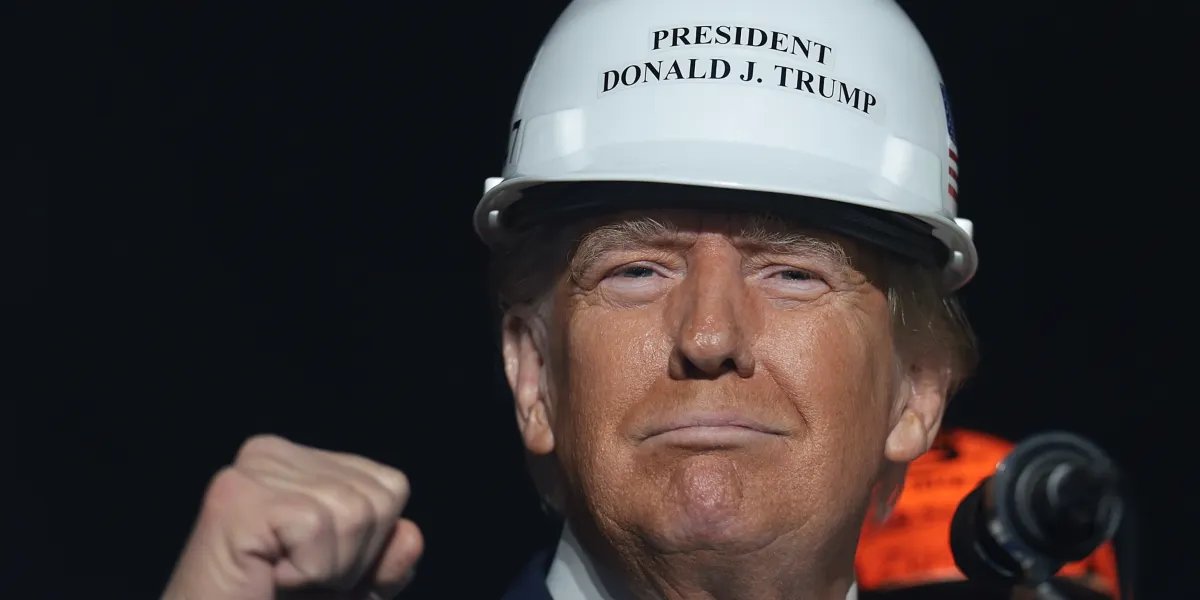

The White House promised a manufacturing renaissance. Instead, the factory floor keeps shrinking. For young men willing to ditch the hard-hat fantasy, the real money is in so-called “pink-collar” work—and the pay is better than anything on the shop floor.
President Donald Trump built a political movement on the promise of restoring blue-collar America: steel mills humming, assembly lines roaring, working-class men back on the job. The data says something very different is happening.
The blue-collar job market has been slowing for more than a year, with jobs in manufacturing and construction racking up roughly 150,000 net losses on an annual basis as of March, per calculations by economist Joey Politano. During Trump’s first year back in the White House, the manufacturing sector alone shed 108,000 jobs—even as the administration touted a coming “manufacturing boom.” The sector most likely to have generated the jobs that replaced them? Health care and social assistance.
“There are jobs available,” Joseph Brusuelas, chief economist at the accounting firm RSM, told The New York Times‘ Talmon Joseph Smith. “However, at this moment, the demand for blue-collar labor is insufficient to match the supply.”
Pink-collar, green paychecks
For decades, nursing and teaching have been coded as women’s work: lower-status, lower-pay, and culturally off-limits for men raised on a diet of MAGA machismo. The pay reality punctures that myth entirely.
Registered nurses earned a median salary of $93,600 in 2024, according to the Bureau of Labor Statistics. Production workers—the backbone of the manufacturing economy Trump has promised to revive—earned a mean annual wage of $50,090 over the same period. The gap is nearly $40,000 a year. The factory floor doesn’t just offer fewer jobs—it offers significantly less money.
Career stability compounds the advantage. The BLS projects 193,100 registered nurse job openings per year through 2032, driven by retirements and rising demand. Manufacturing, meanwhile, has automated away 1.7 million jobs since 2000, Oxford Economics estimated, and could displace as many as 20 million more by 2030—tariffs or no tariffs.
The masculinity trap
The men most hurt by the MAGA economy’s broken promises are the same ones most culturally resistant to the jobs actually on offer. Prime-age male labor force participation—men between 25 and 54—has trended downward for decades, with the share of men sitting entirely outside the labor force holding at roughly 11%. That figure has remained stubbornly elevated even as the broader post-COVID economy recovered.
The mismatch is stark. HRSA and HHS data through 2025 show RN demand grew 3% while supply grew only 1%, producing an actual deficit of roughly 295,800 nurses nationwide—a figure that falls within McKinsey’s 2022 forecast of a 200,000–450,000 shortfall. Yet, men make up just 12% to 13% of the registered nursing workforce—a figure that has barely budged despite slow gains since the 1970s, when male nurses made up just 2.7% of the profession. “Nurse Dana” from The Pitt would be uniquely positioned to benefit from the AI economy, with her skills in high demand, but even that award-winning series has a dearth of male nurses.
Teaching tells a similar story. Men accounted for just 23% of the public school teaching workforce in the 2024–25 school year, a share barely changed since 2011–12. At the elementary level, the figure collapses to 11%.
The irony is sharp. The same working-class men the MAGA economy promised to rescue are sitting out a hiring boom in the fastest-growing sectors of the U.S. economy because those jobs are considered women’s work. Meanwhile, the factories they’re waiting to return to keep shedding workers.
The hard-hat renaissance isn’t coming. The stethoscope and the lesson plan are already here.
For this story, Fortune journalists used generative AI as a research tool. An editor verified the accuracy of the information before publishing.