President Trump’s latest sanctions against Iran have forced the cancellation of English proficiency and graduate exams that Iranians rely on to qualify for studying abroad, students and testing services say, penalizing Iranians who are eager to foster relationships with the outside world.
Among those organizations that canceled exams are the Educational Testing Service, which runs the Test of English as a Foreign Language (TOEFL) and the Graduate Record Examination (GRE). They are two of the most widely used exams for students seeking admission to English-language graduate programs worldwide.
The Duolingo English Test, an online standardized exam increasingly used by students applying for undergraduate programs, has also suspended testing for anyone who is Iranian and cannot register as the citizen of another country.
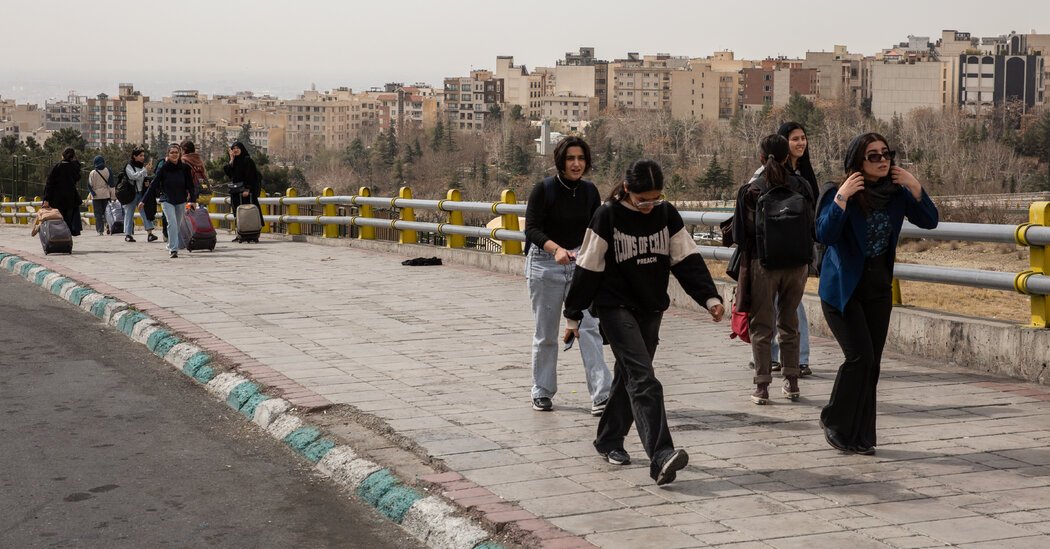
Iranian students whose exams were canceled described a growing sense of despair. They said the sanctions were hurting the people who most want to pursue relations with an outside world so often closed off to them by Iran’s clerical rulers and decades of economic isolation.
“I feel like the right to strive for a better life — even the right to dream of one — has been taken away from me,” said Shahrzad, a 28-year-old who was notified this week of her TOEFL cancellation. Like other Iranian students interviewed for this article, she spoke on the condition that her last name be withheld for fear of government retaliation for speaking to foreign media.
For 43 nights, Shahrzad said, she and her husband stayed up late after putting their small daughter to bed to prepare for their TOEFL exams. They hoped to study in Europe and start a new life out of reach of Iran’s authoritarian rulers. She said she planned to get a higher degree in education, while her husband would continue his studies as a mechanical engineer.
“Isn’t America known by everyone as the land of dreams?” she asked. “Why is this country taking our dreams away from us?”
The Trump administration last week announced expanded sanctions, which aim to further isolate Iran at a time when its economy is already in free-fall amid rapid deprecation of its currency and a fuel crisis, as well as soaring inflation and unemployment. More and more Iranians, worn down by war, are sinking into poverty.
Previous rounds of U.S. sanctions offered exemptions to allow educational exchange and exams to continue, but the new measures suspended General License G, which had permitted educational services to be offered to Iranians.
Kristen Mitchell, a spokeswoman for the Educational Testing Service, confirmed that the TOEFL and GRE test offerings in Iran were canceled but said Iranians could travel abroad for testing. “We are actively working to understand the scope and duration of this change and pursue any available paths to resume service,” she said.
A spokeswoman for Duolingo confirmed the cancellation of its testing services because of the new U.S. measures. She said the company was required to stop offering its English test to people in Iran or to those using Iranian government-issued identification outside the country beginning Sept. 1.
Treasury officials did not immediately respond to a request for comment.
Esmaeil Baghaei, spokesman for Iran’s Foreign Ministry, said at a news conference on Tuesday that the sanctions showed the United States’ stated concerns over Iran’s nuclear program were insincere and that “the United States considers each and every Iranian citizen a legitimate target in all areas.”
On one Telegram chat group for Iranians planning to take the TOEFL, panicked students, who said they had spent months preparing for the exam, were organizing letter-writing campaigns to beg the testing services to restore their offerings.
The cancellations are the latest in a string of hurdles Iranian students have faced.
Amir, a civil engineer from the northeastern city of Mashhad, said the Trump administration’s 2025 travel ban on 19 countries, including Iran, made it impossible for him to study in the United States.
He then began studying for the International English Language Testing System exam run by British and Australian companies. But international restrictions on banking with Iran forced the company that runs that test to halt its offerings in Iran last year.
Amir then switched to studying for the TOEFL, available in Iran at the time, only for his test to be delayed when security forces cracked down on antigovernment protests in January and a three-month blackout of the internet halted most test offerings.
He was forced to wait again after the United States and Israel launched their war on Iran in February. After hostilities ebbed in recent months, he planned to finally sit for the TOEFL exam — only for it to be canceled.
Amir said that many of those most critical of the regime are keen for opportunities to study abroad and engage with the United States and other countries in the West, but that these Iranians were particularly hard hit by the latest sanctions. “In a way, the Trump administration is helping the Islamic Republic keep us trapped here,” he said.
Students who could scrape together the cost of travel said they would try to take their exams in neighboring Turkey or Armenia. Deteriorating economic conditions, some noted, would put travel abroad for the exams out of reach for many Iranians.
“The cost of this trip alone would be more than what my entire family spends on food for a whole year,” said Mahdiyeh, a 26-year-old graduate student in Tehran.
For the past six months, she said, she had worked in a shop to save money for her TOEFL exam and apply for doctoral programs in Europe after Mr. Trump’s travel ban made study in the United States impossible.
She called the new sanctions an injustice against “people who have done nothing wrong in their lives except being born in Iran.”
Like many students interviewed, Mahdiyeh was skeptical that such sanctions would change the behavior of Iran’s government. “But they will be remembered as a dark stain on the academic history of the United States,” she said.
The Trump administration’s new sanctions are so wide ranging that they almost seem intended to impact ordinary Iranians, said Kamran Baradaran, an Iranian author who writes about international affairs.
“It remains obscure how this new decision by the U.S. government is supposed to advance the White House’s mandate against the ruling government in Iran,” he said. “In this dynamic, it is not officialdom but ordinary citizens who bear the brunt.”
A few days before their TOEFL exam was canceled, Shahrzad’s husband took a picture of her, seated beneath a giant map of the globe and hunched over her books studying.
“We wanted to look back at it one day, when we had finally achieved our dream, and remember how difficult the road had been to get there,” she said.
Leily Nikounazar contributed reporting.