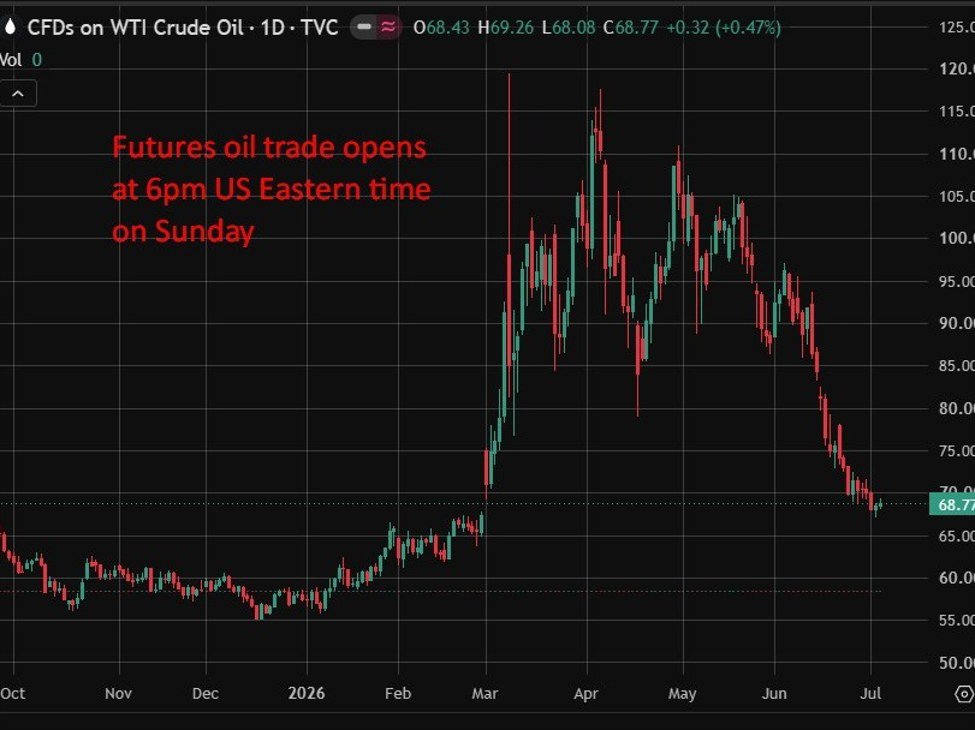
The episode highlights how fragile the strait’s reopening remains even after the mid-June US-Iran deal, with shipping volumes still running well below pre-war levels and vulnerable to sudden disruption whenever Iran presses its claim over the authorized transit route. The rise in ships going dark, switching off transponders to avoid detection, points to growing uncertainty among tanker operators about which route carries less risk, a dynamic that is likely to keep freight rates and war-risk insurance premiums elevated through the corridor. Traders will continue to watch daily crossing counts as a proxy for how quickly physical oil flows can normalise, with the gap between observed and actual dark transits adding a layer of noise to that signal.
At least eight vessels U-turned in the Strait of Hormuz over the weekend as Iran pressed its own transit route, before shipping along the US-protected Omani corridor showed signs of recovering Sunday, Kpler and ship-tracking data show.
Summary:
- At least eight ships, including oil tankers, bulk carriers and vehicle carriers, U-turned while attempting to leave the Persian Gulf along the Omani coast between Friday and Saturday
- Four of the vessels subsequently sailed northward to exit via the route dictated by Iran instead of continuing along the US-protected Omani corridor
- Shipping along the Omani route showed signs of recovering Sunday, with six oil and gas freighters observed navigating close to Oman’s coast and one fuel tanker making a fresh transit attempt
- Western navies say the threat risk in the strait remains substantial and that its center has been mined, while Iran continues to insist vessels use its authorized route
- Around 34 commodity vessels crossed the strait daily on average since the preceding Monday, an improvement on wartime levels but still well below pre-war norms
- Many vessels are transiting with transponders switched off to avoid detection, meaning official daily crossing counts likely understate the true volume of traffic
At least eight ships attempting to leave the Persian Gulf along the Omani coast performed unexplained U-turns between Friday and Saturday, the latest sign that reopening the Strait of Hormuz remains complicated by Iran’s efforts to assert control over the vital waterway.
The vessels, which included oil tankers, bulk carriers and vehicle carriers, were tracked sailing toward the strait, with some reaching as far as the tip of the Musandam Peninsula before reversing course. Four of them, comprising one crude tanker, two products tankers and one bulk carrier, subsequently sailed northward to exit via a route closer to Iran rather than continuing along the US-protected corridor near Oman. There has been no official explanation for the reversals, though Iran has repeatedly said vessels should only transit the strait through its own authorized route, and ships attempting to leave the Gulf have previously reported radio warnings from Iranian forces demanding permission from Tehran before crossing.
Shipping along the Omani route showed signs of recovering by Sunday, with six oil and gas freighters observed navigating close to Oman’s coastline. One fuel tanker appeared to be making a fresh transit attempt past Musandam, while a products tanker that had transited earlier was broadcasting its position in the Gulf of Oman. Other vessels opted to cross without transponders switched on, only becoming visible again once clear of the waterway, including a Suezmax crude carrier that surfaced in the Gulf of Oman after last broadcasting from within the Persian Gulf a day earlier. Western naval forces continue to describe the threat level in the strait as substantial and say its center remains mined.
Crossing volumes have improved from the depths of the conflict but remain far below pre-war norms. Around 34 commodity vessels crossed the strait daily on average in the days leading up to the weekend, with 65 ships crossing along the Omani side between June 30 and July 1 alone, 59 of them supported by the United States. Despite the mid-June deal between Washington and Tehran aimed at reopening the strait, Iran has continued to assert its own authority over the corridor, leaving tanker companies to weigh the competing risks of each route as the market works toward a fuller normalization of oil shipping through one of the world’s most important chokepoints.