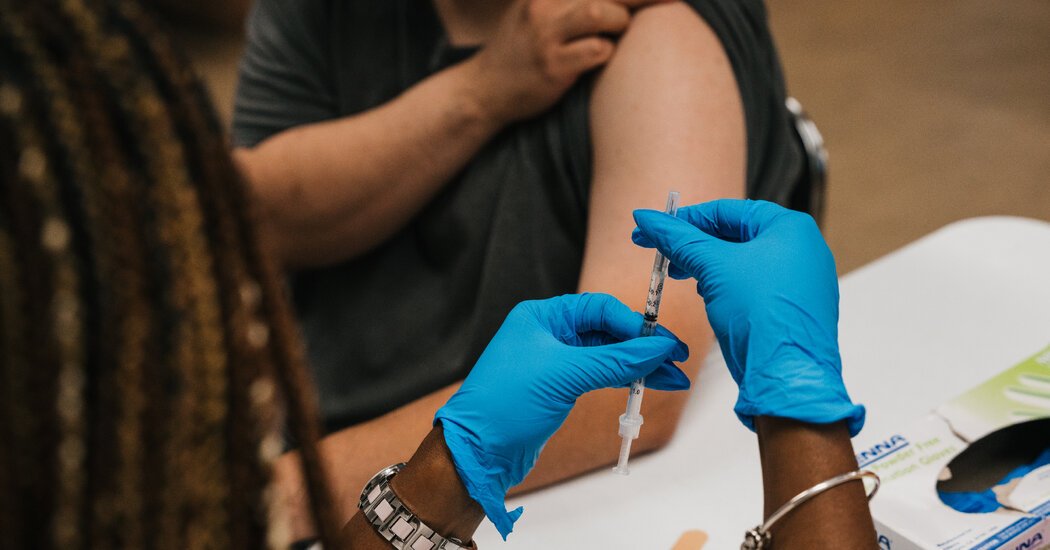
The Food and Drug Administration approved updated Covid vaccines on Thursday, clearing the way for manufacturers to ship doses to pharmacies and doctors’ offices.
Moderna and Pfizer, which make the most commonly used Covid vaccines, are expected to begin shipping soon; Pfizer said it would do so “immediately,” and Moderna has done so within days of approval in past years. Sanofi, which distributes a non-mRNA option called Nuvaxovid (commonly known as Novavax), said doses would be available in the coming days, with the timing varying by location.
However, criteria set by the F.D.A. and a legal dispute stemming from past Trump administration actions could complicate access for some people.
Here is what we know. This article will be updated as more information becomes available.
Who is eligible for the vaccines?
As was the case last year, the F.D.A. approved the shots for all people 65 and older, as well as for younger people who have a condition that increases their risk of severe illness from Covid. The Moderna shot is approved for ages 6 months and older; the Pfizer shot for ages 5 years and older; and the Sanofi shot for ages 12 years and older. (A lower-dose Moderna shot, called mNexspike, was also approved for ages 12 and up.)
About 30 percent to 60 percent of Americans have a qualifying condition, F.D.A. officials estimated last year. Aside from age, a long list of factors can increase the risk of severe illness. They include asthma, diabetes, obesity, physical inactivity and pregnancy, as well as cancer, immune deficiency, some mental illnesses and various heart and lung diseases.
People who are not formally eligible may still be able to get vaccinated. Doctors can administer vaccines off label, meaning outside F.D.A. approval criteria.
But there may be logistical hurdles: Because most Americans who get Covid shots do so at pharmacies, not all doctors’ offices stock the vaccine. And pharmacists in some states may be unable, or may decline, to administer shots off label.
Last year, after significant initial confusion, Walgreens and CVS — two of the nation’s largest pharmacy chains — allowed people to self-attest that they met the criteria, without requiring medical documentation. The companies did not immediately respond to requests to confirm what their policies would be this year.
Can I get a vaccine at a pharmacy?
In most states, the answer is likely to be yes. But some states may not let pharmacists give vaccines that the Centers for Disease Control and Prevention has not recommended, as millions of Americans discovered last year.
Normally, the C.D.C.’s vaccine panel would recommend the new shots either for everyone or for specific groups. But the panel is in legal limbo after a federal court ruling in March that temporarily invalidated the appointments of members chosen by Health Secretary Robert F. Kennedy Jr.
Amy Thibault, a spokeswoman for CVS, said it expected to begin administering doses within days “to eligible patients in all states as permitted by law.” However, it is not yet clear how that will look in specific states.
That should become clearer, for CVS and other pharmacies, in the coming days. Pharmacies’ websites will let people check availability in their area. But keep in mind that if you see no or limited availability near you, that may not be permanent. Last year, access expanded significantly over several weeks.
Will insurance cover the vaccines?
We can’t say for sure yet.
Almost all insurers have to cover shots recommended by the C.D.C. panel, the Advisory Committee on Immunization Practices. But the panel’s suspended status raises questions.
In the absence of an A.C.I.P. recommendation, Medicare still has to cover the shots, but private insurers don’t, said Dorit Reiss, a vaccine policy expert at the University of California College of the Law, San Francisco.
But that doesn’t necessarily mean insurers won’t cover the shots. AHIP, a trade organization that includes most major insurers, said its members would continue to pay for Covid vaccines, as did UnitedHealthcare, which isn’t part of AHIP. (Always double-check with your insurer, because some employer-sponsored plans may differ from their parent companies.)
The area of most uncertainty is the Vaccines for Children program, which about half of American children rely on for free vaccinations. The C.D.C. ships the doses provided through this program, and if there is no C.D.C. recommendation, it’s not clear whether those shipments will happen, Ms. Reiss said.
Emily Hilliard, a spokeswoman for the Department of Health and Human Services, did not respond to a request for comment on V.F.C. coverage.
How effective are the vaccines?
The updated vaccines target the XFG variant of Covid, as an F.D.A. committee recommended this spring. That should be a good match for the virus that is circulating, said Dr. Ian Mellis, an assistant professor of pathology and cell biology at Columbia University.
XFG is the most common variant in North America as of late August, and closely related variants account for most other cases, Dr. Mellis said. One variant, BA.3.2, is less related but is decreasing.
The shots should significantly increase antibodies that can prevent Covid and reduce symptoms if you do become infected, Dr. Mellis said.
When should I get one?
There isn’t a clear consensus. Ask your doctor if you’re not sure about timing, especially if you’re in a higher-risk group. (If you had Covid recently, wait three months.)
Dr. William Schaffner, a professor and infectious disease specialist at Vanderbilt University Medical Center, said October was the ideal time for both Covid and flu shots, to provide the best protection during the respiratory virus season. Protection wanes after a few months.
But Dr. Peter Chin-Hong, a professor and infectious disease specialist at the University of California, San Francisco, recommended that high-risk people get vaccinated against Covid as soon as the new shots are available, while waiting until October for a flu shot. (It would be reasonable for people under 65 with no high-risk conditions to time their Covid shot more “strategically” ahead of the holidays or travel, he said.) While we can expect a winter wave, he noted, there is also a summer wave happening now.
Are the vaccines safe?
Yes. Like all vaccines, Covid shots can have side effects, almost always mild and brief. But a large body of research has shown that the benefits outweigh the risks.
It’s common to have a sore arm or flulike symptoms for a day or two, as the vaccine stimulates your immune system to build protection against the virus. Very rarely — in a fraction of a percent of patients — Covid vaccines have been associated with heart inflammation. But you are much more likely to develop this from Covid than from vaccination.
How high is Covid risk?
As of late August, a Covid wave appears to be underway. Wastewater shows rising levels of coronavirus in most of the country.
Waves in the last couple of years have been much smaller than those early in the pandemic. And because of vaccination and prior infections, far fewer cases lead to hospitalization and death. But that doesn’t mean the risks of severe illness or long Covid are gone.
“The number of very sick people continues to decrease, but we will still see very sick individuals go to the hospital. We will see people die,” Dr. Chin-Hong said. “It’s hard to have an average message.”