This article originally appeared on Iran So Far Away and was republished with permission.
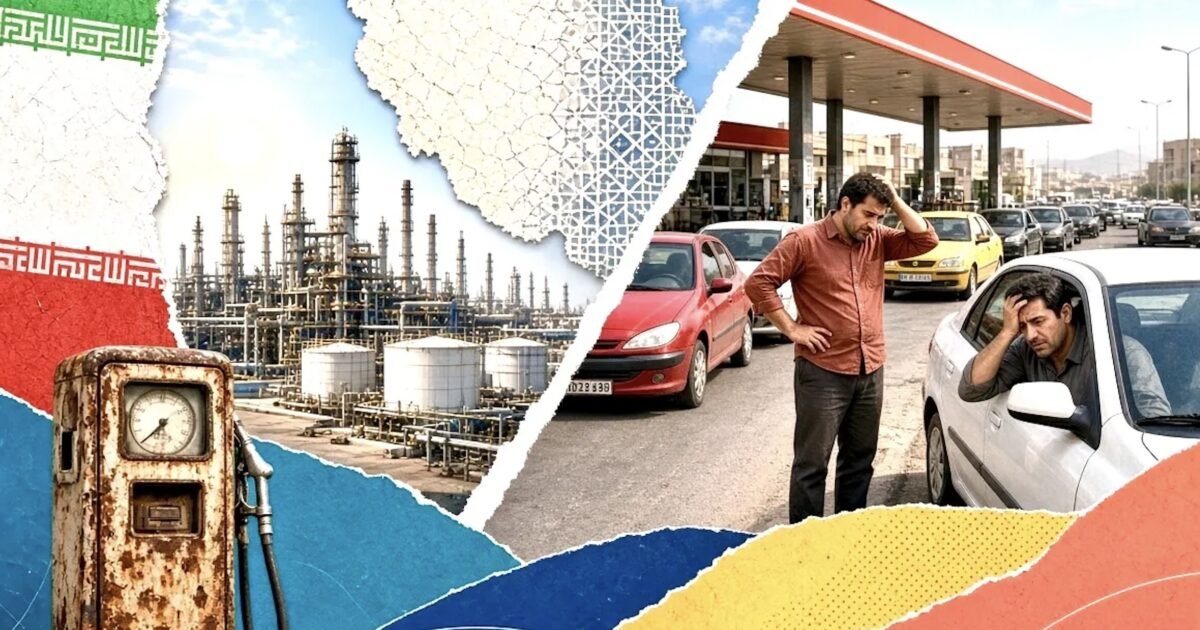
There are few images more politically embarrassing for an oil state than a line of cars waiting for gasoline.
Russia has them. Iran has them. And the spectacle is particularly striking because these are not countries poor in energy. They are among the most resource-rich states on earth, countries that have built foreign policy and political power around their ability to extract and export hydrocarbons.
Yet motorists are searching for functioning pumps, stations are running dry, and two regimes accustomed to discussing oil in millions of barrels are confronting the far more intimate question of whether an ordinary citizen can fill a tank.
Crude oil in the ground is not gasoline in a car. Between the two stands an entire civilization of infrastructure: refineries, pipelines, storage facilities, ports, tankers, spare parts, electrical grids, transportation networks, financing, foreign exchange and competent administration.
A country may possess extraordinary natural wealth and still be unable to convert that wealth efficiently into what its population needs.
Iran is becoming a particularly stark example.
The Islamic Republic controls a country with the world’s third-largest proven oil reserves and second-largest natural-gas reserves. Yet Iranian officials are now confronting a significant gap between domestic gasoline production and consumption. Estimates vary, but Iran is producing roughly 120 to 130 million liters of gasoline a day while consuming approximately 135 million or more.
The deficit did not suddenly appear because of the latest confrontation with the United States. War has made it more dangerous, but the underlying problem is older.
Iran had already returned to importing gasoline because domestic demand was exceeding the capacity of its refining system. Much of that infrastructure is aging.
Years of sanctions have complicated modernization, investment and access to technology. Consumption has meanwhile continued to grow, encouraged by extremely cheap subsidized fuel, inefficient vehicles and an economic system in which gasoline has long been treated not simply as a commodity but as a political entitlement.
Now the margin for managing that imbalance is shrinking.
The interruption of normal trade, restrictions on shipping, falling oil exports and the difficulties of importing refined products have transformed a chronic structural weakness into a much more immediate problem.
The roots of today’s gasoline shortage reach back to the Iran-Iraq War, when major refineries like Abadan were heavily damaged, and never fully restored to their former capacity or technological standard. In the decades that followed, the regime consistently prioritized other projects—its nuclear program, missiles, regional interventions— while underinvesting in refinery modernization. The result is a stark irony: a nation sitting atop some of the world’s largest oil and gas reserves, struggling to produce enough gasoline for its own people.
Russia, which might under different circumstances have helped compensate for shortages, is wrestling with its own fuel crisis after repeated Ukrainian attacks on Russian refining capacity.
Two energy powers are therefore confronting variations of the same irony: immense petroleum wealth coupled with an increasingly fragile ability to deliver fuel where it is actually needed.
In Iran, the implications go far beyond the inconvenience of finding gasoline.
Abdolnaser Hemmati, the governor of Iran’s Central Bank, recently made an extraordinary admission on Iranian television. Discussing the country’s deteriorating economic position, he said that Iran was no longer exporting oil.
The statement should not necessarily be interpreted as a precise accounting figure. Independent tanker tracking indicates that some Iranian crude has continued to move, although volumes have fallen dramatically.
Hemmati’s admission has its significance elsewhere. A senior official of the Islamic Republic was publicly acknowledging something the state has spent decades trying to prevent: the strangulation of the economic mechanism upon which the regime itself depends.
Iran does not merely sell oil. Oil revenue provides foreign exchange. Foreign exchange helps pay for imports. Imports compensate for weaknesses in domestic production.
When exports collapse while gasoline production fails to meet domestic demand, the country becomes trapped in a vicious circle. It needs the income generated by one part of its petroleum economy partly to repair the failures of another.
For a normal government, this would constitute a serious economic problem.
For the Islamic Republic, gasoline is also a political memory.
Iran has been here before.
In 2007, the government of Mahmoud Ahmadinejad introduced gasoline rationing. The response was immediate. Petrol stations were attacked and set ablaze in Tehran. The anger was not difficult to understand. Ordinary Iranians living above one of the greatest petroleum reserves on earth were being told that their government could not provide enough gasoline.
The underlying problem then was remarkably similar to the one Iran confronts today: vast crude reserves combined with insufficient refining capacity and dependence on imported fuel.
Twelve years later, gasoline became explosive again.
In November 2019, the government abruptly raised fuel prices. The demonstrations that followed quickly ceased to be protests about gasoline alone. They became protests against the political order. The authorities shut down much of the country’s internet access and responded with extraordinary violence. Hundreds of Iranians were killed.
No Iranian government can now alter gasoline prices without remembering November 2019.
The current leadership plainly understands this.
President Masoud Pezeshkian has announced plans to raise the price of gasoline purchased in the highest pricing tier, while leaving heavily subsidized allocations in place for the moment.
Economically, the logic is obvious. Iran cannot indefinitely sell fuel at prices radically disconnected from its production and replacement costs. Politically, however, gasoline prices occupy dangerous territory.
The subsidy itself has created many of the distortions now haunting the country.
Artificially cheap gasoline encourages consumption. It discourages efficiency. It supports an aging fleet of vehicles with notoriously high fuel use. Most perversely, it has made smuggling enormously profitable.
When the price of gasoline inside Iran is dramatically lower than in neighboring countries, moving subsidized Iranian fuel across the border becomes an industry of its own.
The Iranian state therefore subsidizes fuel at immense cost, loses part of that fuel to illegal export, struggles to produce enough gasoline to satisfy domestic consumption, and must sometimes import gasoline into a country sitting on some of the largest oil and gas deposits on the planet.
It would be difficult to design a more concise illustration of economic dysfunction.
Sanctions are part of this story and should not be treated as an incidental detail. They have restricted investment, financing, technology transfers, infrastructure development and access to global markets. The present military conflict has intensified those pressures enormously.
But sanctions alone cannot explain a problem that has recurred across different phases of the Islamic Republic’s history.
Iran’s gasoline predicament is also the cumulative product of political choices: decades of economic isolation, corruption, distorted subsidies, underinvestment, institutional incompetence, prioritization of ideological and regional projects, and the deterioration of an economy that should, given the country’s natural endowments and educated population, be vastly more productive than it is.
That distinction matters because there is always a temptation outside Iran to interpret shortages as proof that external pressure is “working.”
Working toward what?
Economic pressure does not descend neatly upon governments while sparing populations. It travels through societies. A gasoline shortage means that a taxi driver spends part of his working day searching for fuel. A delivery business loses hours. Transportation costs rise. Food becomes more expensive.
Families already living under severe inflation lose another portion of their purchasing power. People who had no role in deciding the policies that produced international confrontation absorb the consequences of those policies from both directions.
The Islamic Republic possesses mechanisms for protecting itself that ordinary Iranians do not.
Security institutions will receive fuel. Politically indispensable agencies will receive fuel. Resources can be diverted toward the organizations upon which the regime depends. A state accustomed to rationing scarcity can determine who receives what remains.
The man waiting at the petrol station cannot.
This is why fuel shortages should not automatically be mistaken for imminent regime collapse. Authoritarian governments have demonstrated repeatedly that they can survive extraordinary levels of economic dysfunction, particularly when they are willing to transfer the cost of that dysfunction to their populations and suppress those who object.
Yet survival and stability are not the same thing.
There is something unusually dangerous about shortages that can be seen and experienced directly.
A government can dispute inflation statistics. It can manipulate exchange rates. It can claim that oil exports are higher than foreign analysts suggest. It can insist that sanctions have failed, that production targets have been met, that another economic plan is succeeding and that tomorrow will be better.
An empty gasoline pump is less accommodating.
A driver does not need an economist to explain a closed petrol station. He does not need an opposition television network to tell him that the queue in front of him exists. He does not require foreign propaganda to calculate how many hours of his day have disappeared while he searches for fuel.
Material failure has a language of its own.
That may ultimately be the most important aspect of what is now happening in Iran.
For nearly half a century, the Khomeinist regime has presented resistance as a governing philosophy. Economic pain could be described as sacrifice, isolation as independence, sanctions as proof of revolutionary virtue and deteriorating living standards as the price of refusing submission to foreign powers.
But political rhetoric encounters limits when ideological abstraction enters everyday life.
Iran is not a poor country in the conventional meaning of the word. It possesses energy, minerals, industry, agriculture, coastlines, strategic geography, an ancient commercial culture and a remarkably educated population. Its predicament has never been a simple absence of resources.
The tragedy lies precisely in the abundance.
A government sitting atop such wealth must explain why scarcity has become ordinary.
Why should one of the great oil-producing civilizations of the world worry about gasoline? Why should an Iranian motorist stand in line for fuel? Why should a country that once possessed the resources, expertise and international relationships necessary to imagine itself among the world’s major industrial powers repeatedly find itself improvising around shortages?
The answer cannot forever be reduced to foreigners.
Foreign pressure is real. War is real. Sanctions are real. Damage to infrastructure is real.
So too are forty-seven years of decisions made in Tehran.
Russia’s current experience provides an illuminating comparison. Ukrainian strikes have damaged refineries and reduced gasoline production even though Russia possesses enormous crude resources. It is a reminder that energy power depends not merely upon what lies beneath the soil but upon the functioning systems that turn natural resources into usable prosperity.
For Iran, however, the lesson is harsher because the fragility preceded the current emergency.
The gasoline queues are therefore more than another wartime inconvenience. They expose the distance between resource wealth and national wealth, between possessing oil and possessing a functioning petroleum economy, between controlling a country and governing it successfully.
The Islamic Republic has spent decades describing Iran as a great power under siege.
The far more uncomfortable question is what Iran might have become had so much of its wealth, talent and national energy not been consumed by the siege mentality itself.
A country with some of the greatest petroleum reserves on earth should not force its citizens to live with gasoline scarcity.
Yet once again, Iranians are being asked to adapt.
And once again, the people paying the price are standing in line.
Ad block users: Some site features may not work correctly while an ad blocker is enabled, because they break scripts and content this website depends on. If you can’t see comments below, for example, please disable your ad blocker.