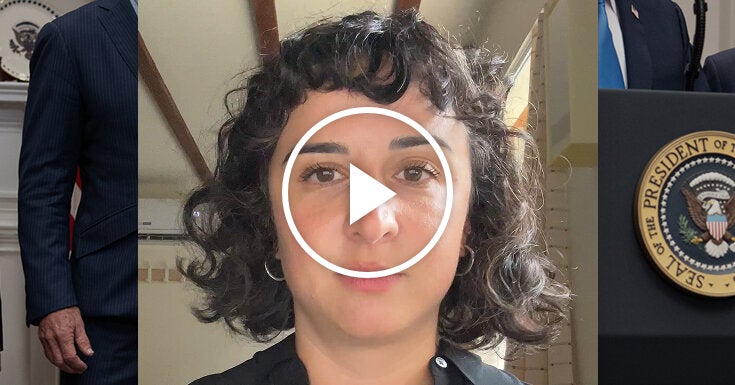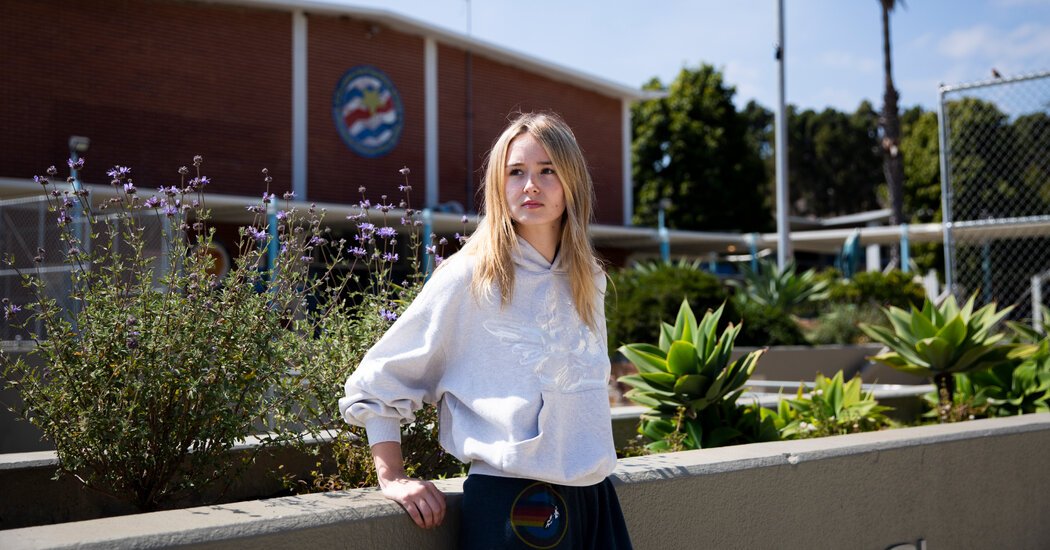
One morning just before Christmas, Michelle stood in a Thrifty-Wash, watching her seven loads of laundry tumble and spin. The machine at the Airbnb had broken and flooded the place. It had been a blessing, in a way — Michelle needed this time alone to think.
The night before, Los Angeles Unified School District officials had hosted a Zoom webinar for parents, in which they had promised to present all the evidence that campus was safe. Michelle had gone in with high hopes, maybe even optimism. Afterward, she called it “the Zoom from hell.”
The officials had opened the meeting by announcing that Pali High’s students would go back to campus at the end of January. Michelle had peered at the screen, squinting to make sense of their color-coded maps, charts and checklists as district officials and their third-party contractors used wonky terms to describe what sounded to Michelle like rudimentary decontamination methods: “visual inspections,” “glove tests,” “subjective evaluations for smoke odor” and the copious use of wet wipes.
The “Environmental Concerns” WhatsApp group began pinging with live commentary. “It’s like they’re all hanging out with my insurance company,” one mother typed. “Transparency my a$$,” wrote another.
During the question-and-answer portion, parents flooded the submission box: Why weren’t the porous ceiling tiles removed? (“We did our best to remove any surface contaminants that we could see visually,” one contractor replied.) Did they realize that lithium had been detected in smoke-damaged homes near the school? (“Lithium, we determined, was not going to be a high-priority metal for us,” another contractor explained.) And why hadn’t they tested for benzene, carbon tetrachloride or perchloroethylene — some of which had been found in other Palisades buildings after the fires?
Michelle had a hunch she knew the answer, but she assumed no official would ever admit it. Then the project manager for one of the contractors came on the screen.
“There are hundreds — literally — of different compounds that could be produced during a fire,” he said, “and there are analytical methods that can be very, very precise in sampling for those.” But the problem, he said, was that it “lacks specificity in what we can actually deal with … ”
Michelle had shaken her head in disbelief. The project manager interrupted himself. “That was the wrong way to put that,” he muttered.
This morning, Michelle had waked to some parents on the “Environmental Concerns” chat talking about putting their kids in virtual learning. Others were hoping to transfer. Michelle was fantasizing about protesting the return to campus, even dreaming up the picket signs: “Lead should only be in pencils,” or maybe, “Test on the school, not on the kids.”