The Canadian economy continues to show signs of slowing. Business investment remains weak, unemployment has moved higher, and overall growth is hovering near stall speed. At the same time, inflation pressures have reemerged, driven largely by higher energy prices and trade-related costs. Against that backdrop, the Bank of Canada has adopted a wait-and-see approach, keeping its policy rate at 2.25% as policymakers assess whether slowing growth or persistent inflation will prove to be the greater challenge in the months ahead. Comments from Prime Minister Mark Carney today reinforced that view, noting that economic data are likely to remain uneven and that investment trends continue to be choppy.
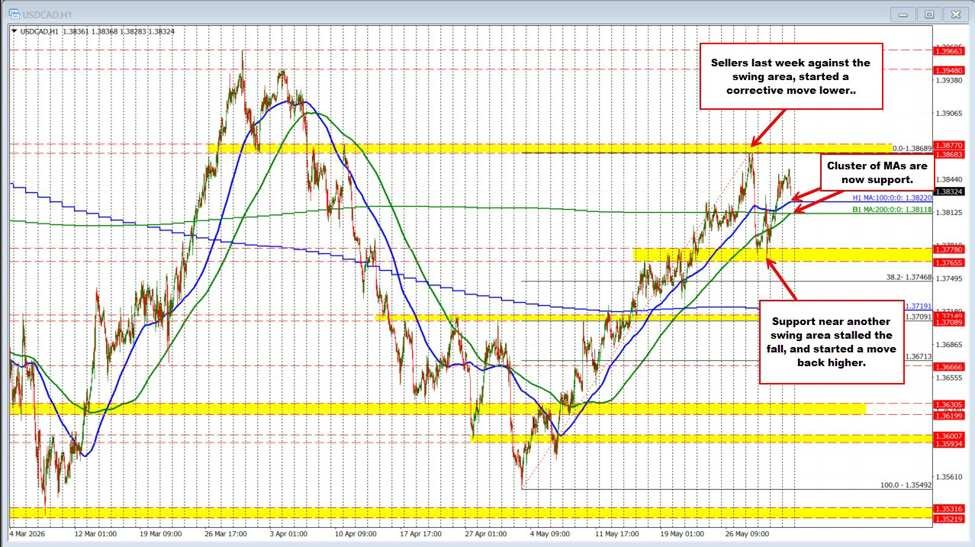
From a technical perspective, the USDCAD declined from late March into early May before staging a recovery through May and into the start of June. Sellers regained some control late last week as the pair corrected lower, but downside momentum faded after support buyers stepped in near a key swing area between 1.3765 and 1.3778. During that decline, the pair fell below a cluster of important moving averages, including the 100-hour moving average, the 200-hour moving average, and the 200-day moving average. However, the inability to extend below the swing area support helped stabilize the market.
The rebound that followed saw the pair base against the 200-hour moving average before climbing back above both the 200-day and 100-hour moving averages, shifting the near-term technical bias back in favor of buyers. In today’s trading, price action has been choppy, with the pair moving lower during the early North American session. That decline has brought the price back toward an important support cluster defined by the rising 100-hour moving average at 1.3822 and the converged 200-hour and 200-day moving averages near 1.3811.
For sellers to regain control, they would need to push the pair below this moving-average cluster and keep it there. Failing that, the recent recovery remains intact, leaving buyers with a modest technical advantage while the market continues to weigh a slowing Canadian economy against a Bank of Canada that remains reluctant to signal its next move.