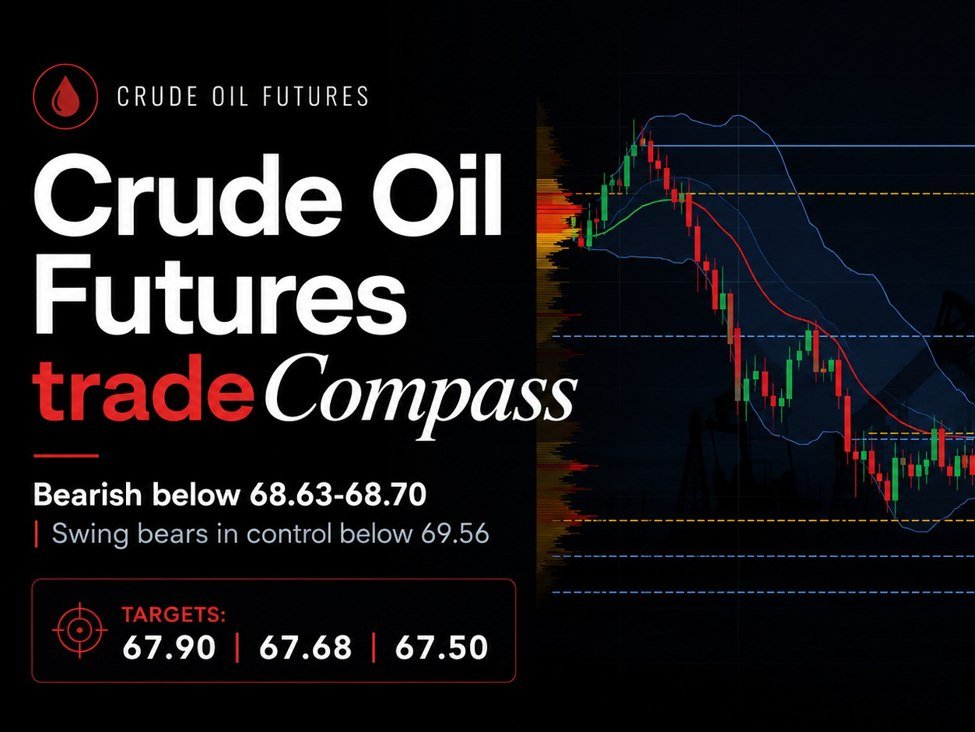
Crude oil futures remain under short-term pressure while price trades near 68.50, just below the key 68.60-68.70 intraday decision zone. For now, the investingLive tradeCompass read stays bear-leaning below that area, while swing traders may prefer to judge the larger bearish case against the higher 69.55-69.60 reference.
For additional market context, Exness analyst Antreas Themistokleous also flagged a bearish broader oil structure in his latest weekly oil and gold analysis, noting that crude remains in a clear downtrend from mid-May. That external view broadly supports the cautious tone here, although the trade levels below come from investingLive’s own intraday map.
Key takeaways for crude oil traders and investors today
-
Intraday bias: Bearish below the 68.60-68.70 decision zone.
-
Swing bias: Still bearish while crude holds below 69.55-69.60.
-
Main downside targets: 67.90, 67.70, then 67.50.
-
Bigger resistance: The 70.95-71.25 area remains important, but it is not the first problem for bulls.
-
External analyst context: Exness analyst Antreas Themistokleous sees crude in a broader downtrend, while allowing for a possible limited relief bounce because momentum is oversold.
What does the crude oil futures chart show today?
Crude oil futures key levels on today’s trading map for oil
At the time of this analysis, crude oil futures are trading near 68.50, almost exactly around today’s POC, or point of control.
What this means: The POC is the price area where the most volume has traded during the session. When price sits near the POC, the market is often balanced in the short term, but direction depends on whether buyers or sellers can push price away from that accepted value area.
The problem for bulls is that crude is still trading below two important short-term VWAP references:
| Reference area | Level | Why it matters |
|---|---|---|
| Friday VWAP | 68.60-68.65 | First intraday resistance |
| Thursday VWAP | 68.70 | Upper edge of the immediate decision zone |
| June 26 VWAP | 69.55-69.60 | More important swing reference |
| June 30 POC | 70.95 | Higher resistance if buyers repair |
| June 30 value area high | 71.25 | Upper range resistance |
What this means: VWAP is a volume-weighted average price. Many intraday and institutional-style traders use it as a fair-value reference. If price remains below VWAP, sellers often still have the cleaner short-term argument.
Why the 68.60-68.70 crude oil zone matters now
For scalpers and intraday traders, 68.60-68.70 is the immediate line in the sand.
As long as crude oil futures remain below this zone, the short-term tradeCompass map leans bearish. A sustained move back above it would weaken the immediate bear case and suggest sellers are losing control of the current session.
This does not automatically make crude bullish. It simply means the first bearish condition has been challenged.
The cleaner bullish repair would need two steps:
| Step | What bulls need to do | Practical meaning |
|---|---|---|
| First repair | Reclaim 68.60-68.70 | Short-term sellers begin losing control |
| Stronger repair | Hold above 69.55-69.60 | Swing bearish structure starts weakening |
| Larger upside test | Move toward 70.95-71.25 | Price revisits the upper range resistance area |
Until those steps happen, the 70.95-71.25 zone remains a distant resistance area rather than an immediate target.
How the Exness oil view fits the investingLive tradeCompass map
The Exness weekly oil and gold note, submitted by analyst Antreas Themistokleous, adds useful broader context to this short-term crude oil read.
Themistokleous noted that crude oil remains in a clear downtrend that began in mid-May, with price pressing against the broader $70 support area. He also pointed to a bearish moving-average crossover, which reinforces the downside structure.
That matters because our shorter-term tradeCompass map is also not showing bullish control yet. Price is below 68.60-68.70, and the larger swing reference near 69.55-69.60 has not been reclaimed.
There is one important balance point, though. Themistokleous also noted that the Stochastic oscillator has been deeply oversold, which can open the door to a short-term relief bounce. In plain English, crude may be bearish without being a clean chase-short at every price.
That is the key practical message for traders: bearish structure does not mean sellers should ignore location. If price is already near prior value or support, partial profits and disciplined trade management matter.
Crude oil bearish targets to monitor
If sellers keep crude oil futures below 68.60-68.70, the near-term downside targets remain realistic:
| Bearish target | Why it matters |
|---|---|
| 67.90 | Just above the July 2 VWAP area |
| 67.70 | Near the July 2 POC |
| 67.50 | Near the July 2 value area low |
These levels are useful because they are linked to prior accepted value, not just random round numbers. Markets often react around earlier high-volume areas because traders who bought or sold there may defend, exit, or reverse positions.
For that reason, bears should consider scaling out into these downside areas rather than assuming crude must move lower in a straight line.
What would weaken the bearish crude oil scenario?
The oil prediction score is still bearish -5, investingLive
The bearish intraday scenario weakens if crude oil futures reclaim and hold above 68.60-68.70.
For swing traders, the more important level is 69.55-69.60. A sustained move above that area, especially if confirmed by two hourly closes above it, would be a reasonable invalidation signal for some short-side traders.
The broader bearish case would become less attractive if price starts building value above 69.60 instead of rejecting from it. That would suggest the market is no longer treating rallies as easy selling opportunities.
Practical crude oil trading plan for today
For now, the crude oil futures map is simple:
| Scenario | Activation | Targets | Invalidation |
|---|---|---|---|
| Bearish intraday scenario | Price remains below 68.60-68.70 | 67.90, 67.70, 67.50 | Sustained reclaim above 68.70 |
| Bearish swing scenario | Price remains below 69.55-69.60 | Lower-value continuation, with 67.50 first important zone | Two hourly closes above 69.60 |
| Bullish repair scenario | Price reclaims 68.70, then 69.60 | 70.95-71.25 | Failure back below 68.60 |
The best trade plans do not only define direction. They define where the idea works, where it weakens, and where it should no longer be trusted.
Why partial profits matter in crude oil futures
Oil can move quickly, especially around inventory data, geopolitical headlines, and macro releases. That makes trade management just as important as the initial direction.
If a bearish trade activates below 68.60-68.70 and reaches 67.90 or 67.70, taking partial profits can reduce emotional pressure. It allows traders to lock in part of the move while keeping a smaller position open in case momentum continues toward 67.50.
This is especially useful for traders using smaller contract sizes or CFD-style products, because they may have more flexibility to scale out gradually instead of making an all-or-nothing decision.
How to know if this crude oil analysis is still valid
This analysis remains useful only if crude oil futures are still trading around the key zones in this map.
If price is still below 68.60-68.70, the intraday bearish read remains active. If price has reclaimed 68.70, the immediate bear case has weakened. If price has accepted above 69.55-69.60, swing bears should be more careful.
If crude has already moved far below 67.50 or far above 71.25, this article should no longer be treated as a fresh setup. At that point, traders should use the levels as context rather than as new entry triggers.
For now, crude oil futures remain bear-leaning below 68.60-68.70 for intraday traders, and below 69.55-69.60 for swing traders. The Exness weekly view from Antreas Themistokleous supports the broader bearish structure, but the market is oversold enough that disciplined entries and partial profit-taking remain important. Trade at your own risk.