
In Part One of this three-part series, reporting by J.M. Phelps detailed how Staff Sgt. Lance Castle was systematically targeted after filing a religious objection to the COVID-19 shot mandate.
This pattern of reprisal, documented repeatedly by Phelps, persisted even after Defense Secretary Lloyd Austin formally rescinded the mandate on Jan. 10, 2023, and directed the armed services to reverse punitive measures taken solely over shot refusal.
Yet by that same month, Castle had already been classified as an “insider threat.” His squadron commander, Lt. Col. Enrique Vazquez, did not recommend him for promotion to technical sergeant. That non-recommendation blocked him from advancing to E-6.
Less than two weeks later, his flight commander, Capt. Liam Lawrence, claimed a prior supervisor, TSgt Benjamin Lipp, believed Castle had been “potentially radicalized by an anti-US government group in the wake of his refusal to take the COVID vaccine” and was a threat to the base.
Squadron members were instructed by Lawrence “not to meet with him one-on-one, to avoid all interactions with him, and under no circumstances to go to his home.” This is a clear example of ostracism. Vazquez added, “I believe SSgt Castle exhibits almost every indicator of an insider threat and should not have access to any sensitive materials or areas.”
To make matters even more egregious, Castle was also given a security termination statement with guidelines outlining the Espionage Act and other criminal statutes (AF IMT 2587) that state, “The penalties prescribed for violations of these statutes through willful acts or gross negligence vary according to the statute the circumstances and the information involved. They range in severity from a fine of not more than $2,500 to life imprisonment or death. Your signature on this form is your acknowledgment that you have been informed of the criminal statutes applicable to espionage and the punishments provided for violation of these statutes.”
Castle refused to sign this form, which marked the beginning of his decision not to sign any document that he deemed deceitful from his chain of command.
In an interview with Castle’s military attorney, Capt. Leeza Tirado, Lipp said he “did not have concern” that Castle was an insider threat.

He described Castle as frustrated with the shot mandate and added, “There was nothing further that I experienced that made me think he was an insider threat.” Lawrence had used Lipp’s name in the insider-threat paperwork, and Vazquez signed off on it.
During Castle’s second trial, Lipp would also confirm under oath that he never requested a no-contact order against Castle. A later order from the incoming group commander, Col. Stuart Churchill, who took over for Col. Roche, would place the no-contact order on multiple people who had direct involvement with the falsified paperwork on Castle that led to his first trial.
The paperwork that labeled him a threat and cut him off from his squadron did not match what his former supervisor actually said under oath.
Two weeks later, Vazquez imposed an Article 15 on Castle for failure to go and disrespect toward Master Sgt. Michael Carey. According to evidence presented by Castle, Carey had authorized his appointments to the chaplain that week yet later submitted documentation alleging his absence from his workplace. It appears that MSgt Carey was building a false paper trail against Castle to later use against him.
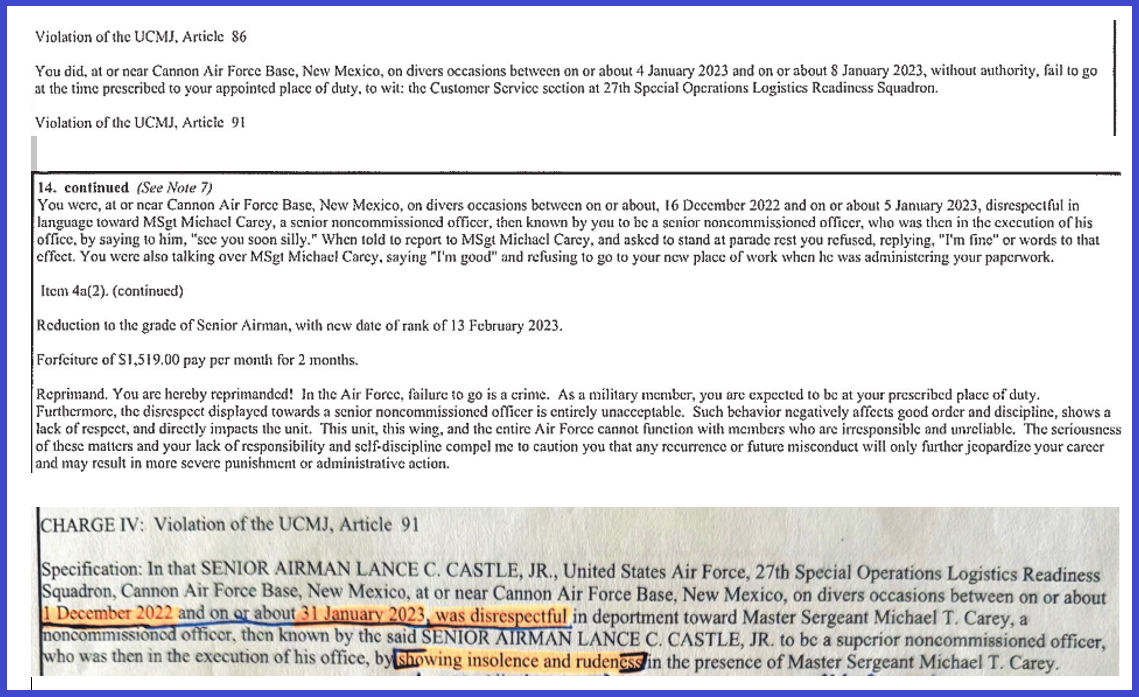
A separate charge of disrespect stemmed from an allegation that Castle failed to assume parade rest while receiving paperwork related to a text message in which he had referred to Carey as “silly.” Castle maintains that he did in fact assume the required position. He was issued yet another Letter of Reprimand (LOR) for this occurrence. It was at this moment that he realized the critical importance of now needing to secretly record every word of all subsequent interactions with his chain of command.
The disrespect allegation would also include in that Castle was talking over Carey. According to Castle, this too was fictitious.
Castle would later be ordered by the successor group commander, Churchill, to no longer be able to audio record any encounter without his permission. Castle viewed this as a strategic move by Churchill to block spontaneous encounters with anyone in his chain of command, whether in the squadron or elsewhere on base.
The new First Sergeant, MSgt Matthew Calhoun, later told him that if he was caught audio recording at any moment, he could be arrested. Castle was also subject to mandatory frisks by security forces with OSI in attendance, including Special Agent Andrew Brown and OSI Commander Special Agent Christopher Riccio, before he could be allowed on base. Churchill was the one behind the searches.
Castle opted for a personal appearance with Vazquez regarding why Article 15 punishments should not be imposed. Castle would secretly fully record the entire encounter. From that meeting, Castle was later charged by Vazquez with “disrespect to a superior commissioned officer.” The charge would claim he called Vazquez a “domestic threat.” Castle submitted a written rebuttal to all allegations in the Article 15, and Vazquez denied the rebuttal. He then submitted an appeal to the group commander, Col. Barry Roche, who also denied it.
Castle now understood the full measure of his opposition. These commanders operated beyond reason, actions governed by whim rather than regulation.
Trending: “Are You F**king Kidding Me…What the F**k is Wrong with You?!” – Leftist Absolutely FREAKS OUT After Seeing How Byron Donalds Addresses Man Dressed as Female
On February 13, 2023, Vazquez reduced him to Senior Airman, after a decade as an NCO, and forfeited $3,038. The insider-threat form still called him a Staff Sergeant. The charge sheet called him a Senior Airman.
During Castle’s trial, Vazquez claimed that Castle “was moved under a different supervisor” because of his stated safety concerns against his supervisor MSgt. Carey.
On March 31, 2023, around noon, he handed Castle, in person, orders sending him back to the same office. The flight commander and first sergeant never made the notification, and Carey himself opened his testimony by stating he was still Castle’s supervisor.
The judge asked whether anyone told Castle that Carey had been removed. Vazquez said, “He didn’t know… That’s something we missed; I missed.”
Days later, Vazquez suspended Castle’s security clearance and access to classified information, writing that he “exhibits almost every indicator of an insider threat.” The same contested narrative that had already produced LORs, an E-6 non-recommendation for promotion, and an Article 15 that resulted in his first rank reduction was now inside the formal security system.
Eleven days after that, Secretary of the Air Force Frank Kendall issued a directive ordering commanders to rescind the mandate guidance and to remove or redact the COVID verbiage from anyone’s files. The insider-threat form still tied the “radicalized toward an anti-U.S. government group” label to the shot. They kept the insider-threat and radicalization labels and left the words “COVID-19” on the document itself. That documentation led to false allegations of “potential active shooter,” “targeting members,” and multiple OSI investigations, including one involving Special Agent Erin Cunningham.
By March 2023, Castle no longer trusted his chain of command or the Inspector General system. In a May 2023 Inspector General complaint that he filed on Vazquez, the IG acknowledged receipt. When Castle checked on its status after his trial in October 2023, they would now tell him that it was lost with the transition to a new system and turnover.
In October 2026, Castle filed yet another formal complaint against Vazquez. It was dismissed and closed without investigation by Lt. Col. Kelly Person due to her citing that he failed to submit the complaint within the year of the alleged misconduct, even though the IG had lost his initial complaint three years prior. Undeterred, Castle bypassed the chain of command entirely, sending a direct email to USAF Inspector General Lt. Gen. David B. Lyons detailing his concerns over Person’s summary dismissal. That complaint remains open and unresolved as of this writing.
Although he had written that he felt unsafe around Carey, command still required Castle to be face-to-face with him. Text messages between Carey and Lawrence revealed that they both plotted for Castle to receive initial feedback from Carey. Lawrence told Carey in text that he hoped Castle wouldn’t attend it so that he could issue him more paperwork.
They would also track Castle’s movements on base, send photographs of his truck, and recommend a BOLO (Be on the Lookout) so he could soon be arrested with the paper trail that they built on him for months.
On multiple occasions when he was expected for meetings, leadership arranged for armed personnel to stand by. On April 3, 2023, two separate memos claimed he was “targeting members” and labeled him a “potential active shooter.”
One memo said there was “a clear motive in the situation that could end fatal for some individuals that work in building 620.” This designation echoed the harrowing experiences of Army 1LT Mark Bashaw from the prior year, illustrating a pattern of military personnel being labeled as insider threats, and threatened with imprisonment, due to their shot-related decisions.
Castle rejected the allegations, telling The Gateway Pundit, “This is literally all fictitious, falsified. None of that is even accurate. Not even close.”
By early April 2023, the decision to take Castle into pretrial confinement was already being coordinated. Between April 3 and 7, a multi-agency discussion involved Mental Health, the Office of Special Investigations, Security Forces, and legal. Vazquez admitted he coordinated with both OSI and Security Forces. He first considered arresting Castle at his residence, then chose the gate. Castle said he was relieved when he was notified of a Team Treatment Meeting scheduled for April 10. “I was more than happy to go, because I would finally be heard by everyone in the room.”
Defense counsel later argued the TTM was used under false pretenses to get him on base for the arrest. On April 10, he was arrested at the gate of Cannon Air Force Base while en route to that meeting.
“No one could tell me what I was being arrested for,” he said. “It was a total ambush.” The charge sheet preferred by Vazquez alleged desertion “with intent to remain away therefrom permanently.”
Castle was apprehended while traveling to a scheduled military healthcare appointment on base. A military judge later ordered his release, noting there was no evidence he was attempting to flee.
Castle spent 66 days in pretrial confinement, from April 10 to June 14, 2023. In his 72-hour confinement memo, Vazquez claimed Castle had struck several Security Forces members and broken one of their noses. That claim became a central reason the Pretrial Confinement Review Officer kept him locked up, including through the birth of his first son.
Anticipating the birth in early June, Castle requested a limited release, even with an escort, so he could be there. His Area Defense Counsel raised the request with Vazquez on May 25. Vazquez said no. He cited the nature of the charges, claimed Castle was a high risk to flee, and then admitted he “felt bad” that Castle would likely miss the birth.
Nine days later, when asked to confirm those reasons by email, Vazquez’s complete response was three words: “That is correct.”
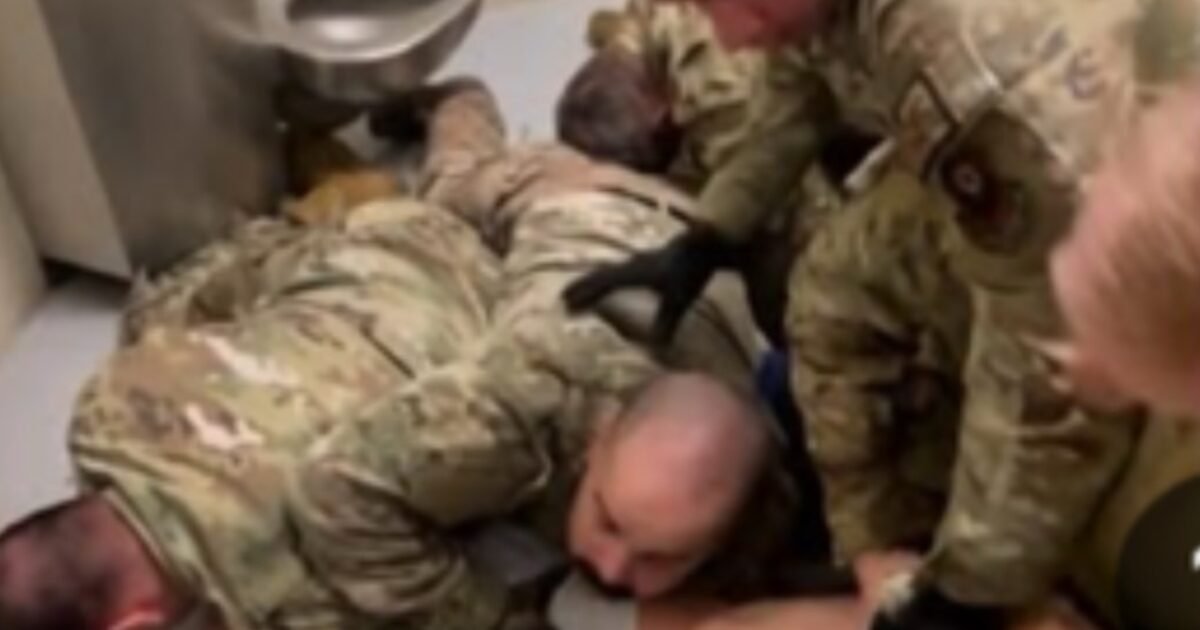
The night of the arrest, about ten to eleven hours later, seven Security Forces members forced him into a restraint chair, cut his uniform and the rest of his clothing off with trauma shears, and conducted a scars, marks, and cavity search. His prescribed blood pressure medication was not ordered, forcing him to go without it for more than 30 days.
The next morning, April 11, the extraction team pulled him from his cell under the guise of noncompliance. Testimony established the team was inexperienced, received no recent refresher training, had no knowledge of the scheduled TTM, and was briefed for only a couple of minutes before entry. No mental health professional or chaplain was involved in any de-escalation attempt.
Group-chat messages from confinement staff later obtained by the defense show they coordinated the extraction to “stun him into compliance.” This forced cell extraction, conducted after falsified charges and later challenged by the defense as an unlawful use of force, left Castle with serious injuries including a torn medial collateral ligament (MCL) and torn rotator cuff that required multiple surgeries less than six months later. They required multiple surgeries in February and April 2024. MRIs confirmed the injuries.
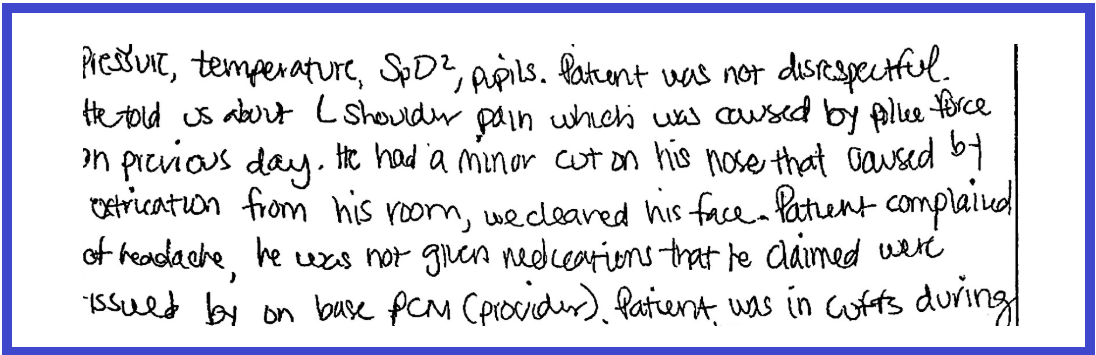
On the morning of the cell extraction, medics documented a laceration on his nose, left-shoulder pain, and shackles around his ankles tight enough that they felt compelled to ask staff to loosen them.
Reacting to the viral incident surrounding this story, Castle’s former wing commander of Kirtland AFB, Retired Col Rob Maness once stated in a public interview: “that squadron commander needs to be held accountable for misusing and abusing the criminal justice system in the Armed Forces, and everybody involved in that process that you just saw, all the way up the chain of command needs to be investigated to find out why this young American, simply because he did what we train our troops to do, refuse unlawful orders, was treated in this manner. It’s despicable.”
In addition, Army Lt Gen Michael Flynn, who previously served as the Director of the Defense Intelligence Agency (DIA) and U.S. National Security Advisor (during the first Trump administration) wrote in an X post: “If there isn’t more to this other than refusing a deadly vaccine, every single person from the top of the chain of command to those involved in this disastrous action directed against a fellow airman must be held accountable. The loss of trust in our armed forces is showing a weariness in the ranks and the inability of our armed forces to accomplish their directed missions is unacceptable.” He continued with, “In years of running interrogation operations against the worst of our enemies, we never treated anyone like this U.S. Air Force Senior Airman was treated. Totally unacceptable behavior top to bottom.”
Interestingly, at trial, the government’s own alleged victim from the incident undercut the confinement justification. Senior Airman Deadrick D. Kelly, testifying as a civilian, said the opposite of what Vazquez had written: “He didn’t hit me.” He explained the injury was “my own fault.” The same commander who preferred the charges had authored the 72-hour memo that relied on injury claims the government’s witness later denied under oath.
When Judge Vicki Marcus pressed Lt. Col. Vazquez about why he still preferred a court-martial specification for the same alleged disrespect after he had already imposed Non-Judicial Punishment for it, Vazquez could not explain his logic. Furthermore, Vazquez admitted under oath that the only threat Castle ever made against him was that he was going to go to the IG and Equal Opportunity office.
The pattern was consistent: negative documentation was added when convenient, altered or removed when it became inconvenient, and then recycled as the basis for more serious charges. Charge I, desertion, was thrown out under Rules for Court-Martial 917 for no evidence. Charge II, the claim that Castle called Vazquez a “domestic threat,” also fell.
Notably, it was only after learning that Castle had recorded their prior meeting that Vazquez testified under oath that Castle never referred to him as a domestic threat.
The machinery of reprisal, once set in motion, proved relentless, operating with a chilling efficiency that outlasted the COVID-19 mandates, overrode sworn testimony, and ultimately failed only when forced into the light of a public courtroom.
On September 13, 2023, Lt. Col. Vicki Marcus found him not guilty of every specification that remained, ruling that the government failed to prove a single charge from that arrest. Yet, the Department of the Air Force treated this judicial exoneration as if it had never happened.
Next week, Part Three will examine the current status of Staff Sergeant Lance Castle’s ongoing legal and professional battles.
AUTHOR’S NOTE: Should any portion of this three-part account be challenged as inaccurate by the Department of the Air Force or any named party or person, the author commits to publishing rebuttals and supplementary articles to ensure clarity, publicly.
Ad block users: Some site features may not work correctly while an ad blocker is enabled, because they break scripts and content this website depends on. If you can’t see comments below, for example, please disable your ad blocker.