The funeral pyres at Kathmandu’s riverfront temple have been burning steadily. But instead of bodies, it is effigies they have set ablaze — shaped out of sacred grass, as if to conjure something tangible of the loved ones who disappeared in Nepal’s devastating floods.
Nine days after the walls of mud and debris tore through a Himalayan valley along the border of Nepal and Tibet, wiping out entire towns, the death toll stands at more than 1,200. Relatives of 5,000 others who are missing have searched hospital to hospital, waiting and waiting, hoping for a miracle — or closure at least.
On Friday, rescuers were racing to recover survivors among dozens of people believed to have been found trapped in a tunnel. But to many whose loved ones are among the missing, resignation has begun to set in. According to Hindu rituals in Nepal, the mourning period after a death is 13 days. If the rites are not performed before the 10th day, the clock resets.
Some families, accepting that they may never receive the actual remains, have chosen to perform a symbolic cremation of a figure made of bundles of kusha grass. Nearly 300 effigy cremations have taken place at the temple during the past three days temple officials said.
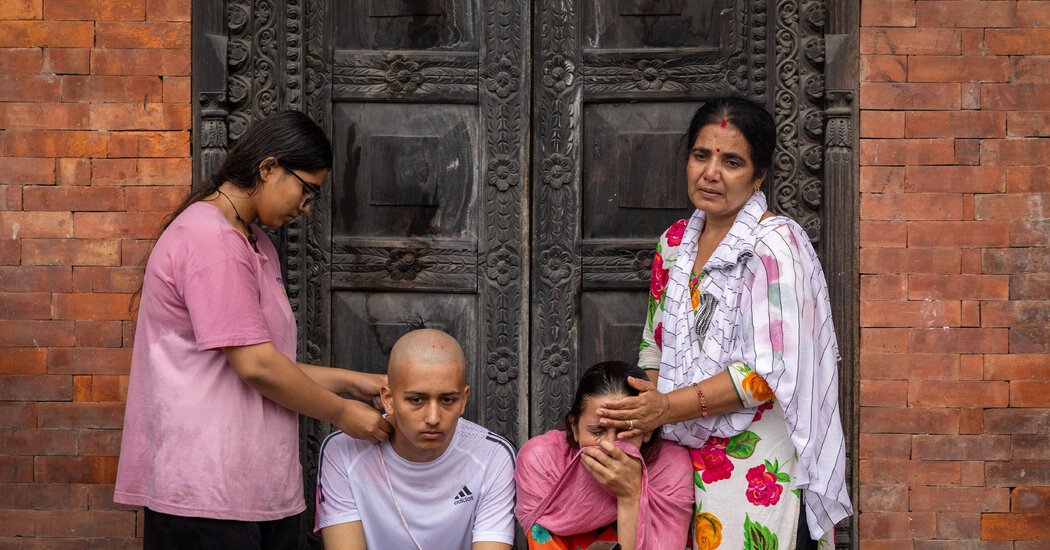
Among the solemn onlookers on Thursday at the temple in Kathmandu, the capital of Nepal, was Darshan Bhattarai, 15, who came to carry out the last rites for his father, Pushpa Raj Bhattarai, 46, one of the thousands dead or missing.
Darshan had been living in the city with his mother, Kamala, and attending a private school thanks to the salary earned by his father, about $300 a month, relatives said. In search of a better life, the family had first moved from Nepal’s eastern hills to the southern plains, where Mr. Bhattarai for years ran a retail shop. About a decade ago, he got a job as an administrative assistant in Nepal’s hydropower sector. He was posted in one of the projects in Trishuli, an area devastated by the floods last week.
Nepal’s hydroelectric projects experienced some of the worst damage from the floods, caused by a glacial collapse that cascaded into an overwhelming rush of mud, gravel and water. Some workers were swept away. Others were trapped in tunnels. Teams of rescue workers have spent days trying to find a way in.
“When his phone went off, we knew something was wrong,” Sukhdev Khanal, a relative of Mr. Bhattarai’s, said. “One of his colleagues had gone out for a smoke, and he survived. He told us later that the rest were swept away.”
After a week of no news, hope dimmed. So Mr. Bhattarai’s family came to the temple in Kathmandu, Pashupatinath Temple, before the 10th day passed, to perform the cremation on the banks of the Bagmati River.
Darshan arrived with his mother and other family and friends. The priest, Rishi Neupane, came with the necessary items for the cremation: kusha grass, kindling wood, rice, ghee and marigolds. A piece of cloth to serve as a shroud. Darshan and his family watched as Mr. Neupune twisted and bound bundles of the grass until it resembled a large straw doll.
As is customary, Darshan’s head had to be shaved as an act of purification before he could perform the ceremony.
He went to a tap on the side of the temple, ran his head under the water and sat on the edge of stair, as a neighbor used a razor and began shaving lock after lock. Darshan giggled as one of his young cousins felt his shaved head, caressing the tuft of hair that is usually left at the crown, a tender moment before the ceremony.
Then, the priest began his work, laying a printed photo of Mr. Bhattarai on a bamboo stretcher and placing the effigy on top.
Through two hours of rituals, Darshan’s face was blank, even when the rain started lashing. Darshan and some of the relatives pulled back, seeking refuge under a ledge, as the priest, and half a dozen men continued. Mr. Bhattarai’s sister-in-law, umbrella in hand, made a video call to his elderly parents in the village, showing them the effigy.
As the rain poured down, Darshan and the men lowered the effigy into the river, for a cleansing bath, as people took turns paying respects to the photo of Mr. Bhattarai.
Praveen Bhattarai, 40, a childhood friend of Mr. Bhattarai’s, was among the mourners. He said he had last seen him during a visit home for the Dussehra festival last year. They had played cards. Mr. Bhattarai was someone who always kept the mood light, he said.
“Doing the last rites like this is very difficult for the family,” Praveen Bhattarai said. “Somewhere, in the depth of their heart, the question will always be there — that maybe he is alive.”
The family lifted the stretcher and walked in a procession, through the thick smoke of other burning pyres, crossing a bridge over the river to the stone platform where Mr. Bhattarai’s pyre would be set.
Darshan lit the fire.
As his uncle steadied him from behind, the young man walked around the effigy as it burned, followed by his mother. They watched it turn to ash, and then Darshan stepped down to submerge some of the ashes in the river.
As the priest read a final prayer from his mobile phone, the family and friends used water from the river to purify the platform where the cremation had taken place.
Mother and son, with relatives holding their arms, slowly made their way through the temple grounds. As they exited, they passed a large group of pilgrims — dancing to drums, singing “Om namah Shiva!” in praise of the god whose spiritual home is nearby.
They kept walking, with Darshan almost being pulled by his uncle, as if sleepwalking into a heavy future.