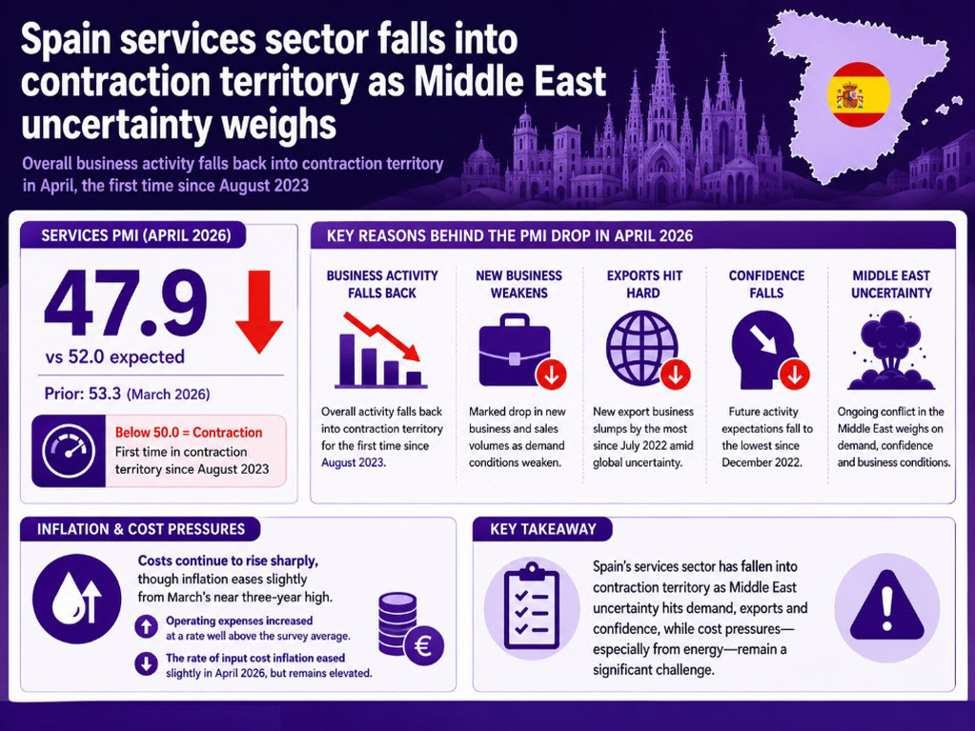
- Services PMI 47.9 vs 52.0 expected
- Prior 53.3
Ouch. That’s a rough hit as Spain’s services sector sees a marked drop in both new business and confidence. The negative impact ties to the Middle East conflict, as costs continue to rise sharply on the month and weighing on demand conditions. HCOB notes that “sales volumes were down
due to a stagnant business environment amid widespread
uncertainty related to the war in the Middle East”.
Adding that new export business was heavily hit, with conditions slumping by the most since July 2022. Meanwhile, sentiment on future activity among Spanish firms also took a heavy knock in falling to the lowest since December 2022.
As for inflation pressures, surging energy prices continue to have an impact with operating expenses increasing at a rate well above the survey
average. That was despite the rate of inflation easing a little
from the near three-year high in March.
HCOB notes that:
“Unlike the somewhat surprisingly decent manufacturing
sector performance – although admittedly here growth
was driven by client stockpiling as part of efforts to
secure goods on fears of product shortages and supply
disruption – the downbeat April PMI figures for services
were somewhat less unexpected in the context of the
knock to confidence that the war in the Middle East has
caused.”
“Fims widely reported that market demand had
softened as widespread uncertainty led businesses and
consumers alike to hesitate when it came to spending
decisions. This was driven in the main by the uncertainty
that the war in the Middle East has caused but also
growing worries over the spectre of inflation as the
impact of the energy price and supply shock ripples
through the global economy.
“Reflecting the impact that the war has had on
sentiment, service providers reported their lowest
level of confidence since late 2022 and this bleaker
assessment of the outlook may well be helping to keep
firms’ pricing power just about in check. Although selling
prices were again raised markedly, the rate of inflation
eased a little since March and crucially remains well
below levels seen back in 2022 and early 2024 suggesting
that full-blown second round inflation effects have yet to
fully materialise.”